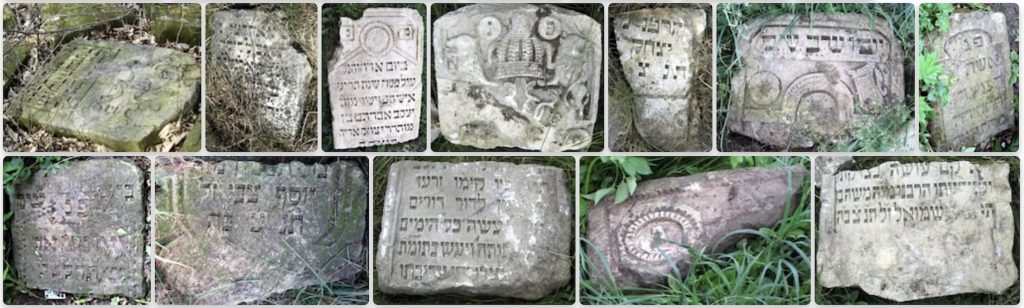

A May 2026 snapshot of the Rohatyn headstone database.
In our annual report at the end of last year, we described our ongoing project to document the few standing headstones and the hundreds of recovered headstones in the Jewish cemeteries of Rohatyn. By that time we had finished documentation of Jewish headstones for four other cities in western Ukraine, but we had completed only one part of the Rohatyn database, making up about 10% of the total number of known headstones. Now we have reached a significant milestone in the Rohatyn data, and we added a new feature to help browse the collection. This status report summarizes what has been done, and what is now in progress, with some interesting examples from the work so far.
 Ця стаття також доступна українською.
As previously described, the larger project is called Jewish Stones UA, and currently covers five cities within 150km of Lviv where Ukrainian, Jewish, and other heritage activists have been working to recover Jewish headstones displaced during or after the German occupation of World War II, and/or to document those stones and anything which remains in the Jewish cemeteries. The five cities include Rohatyn in the Ivano-Frankivsk oblast, Zbarazh in the Ternopil oblast, plus Lviv, Dobromyl, and Sokal in the Lviv oblast.
The Rohatyn Database Project
The larger project and its searchable database structure were developed and tested in 2023 using a handful of typical headstones in Rohatyn, but then applied to all of the other collections except Rohatyn over the next two years. Finally since late last year we are focused on Rohatyn and the more than 1000 headstone photos we have taken in the city since 2011, documenting the stones themselves and also often recording the circumstances of their recovery from streets, gardens, courtyards, waterways, building foundations – and even stuck in a tree!
The database entry for each stone includes:
- an ID number
- one or more photos
- the current location of the stone (name of the place and GPS)
- a brief physical description of the stone material and the carved inscription
- the type of symbol(s) if any at the top of the stone
- a transcription (where possible) of the Hebrew epitaph
- translations of the epitaph into Ukrainian and English
- extracted name(s) and date(s) from the epitaph
- a brief description of the condition of the stone
- a summary of the recovery of the stone (location and date), where known
- additional notes, sometimes including information about the deceased from a death record
Many of the recovered stones are fragments with little or no legible epitaph remaining, but every stone has the potential to reveal a recognizable name and as a whole the collection is gradually bringing a portion of the prewar Jewish community of Rohatyn and environs into focus. Here and there in the collection we have been able to identify known individuals from the city’s history or from surrounding villages; there are Jewish cemeteries in nearby Kniahynychi, Putiatyntsi, Stratyn, and Zhuriv, but the smaller communities in other places nearby normally buried their dead in Rohatyn.
As of this writing, the Rohatyn headstone database includes more than 200 of the over 500 photographed stones and fragments, comprising all 54 “grounded” stones (coded RG, and still anchored in the soil of one of the two cemeteries), 100 of the more than 400 “loose” stones (coded RL, most of which have been recovered to the old cemetery since 2011), and all 58 “missing” stones (coded RX, and known only from prewar photographs of the cemeteries). Thus the overall documentation effort is roughly 40% complete now.
Work continues now on the loose stones, more or less in sequence of their recovery and first capture in photographs. The documentation process is time-consuming; decrypting the worn and often fragmented Hebrew epitaphs is by far the most difficult part. We are fortunate to have Tetiana Fedoriv, a skilled and indefatigable contractor and volunteer, tackling this task among her several other Jewish heritage projects, together with past partial translations by members of the Rohatyn District Research Group (RDRG), who also provided some of the links to prewar vital records in Polish archives for individual stones.
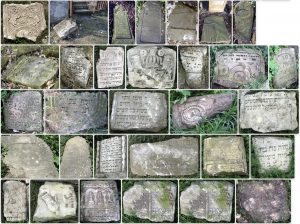
A small part of the new headstone image gallery in the database.
A new feature of the database is a browsable gallery of images of the individual headstones in sequence by stone ID. Developed by Vasyl Yuzyshyn, who programmed the database and who provides ongoing Hebrew and Ukrainian data entry, the gallery gives both a broad view of the headstone collection as we document it and links to the individual stone ID pages for further study. Galleries like this one for Rohatyn are also now available for the other four sites in the larger database.
Some Interesting Examples
A quick glance at the full Rohatyn database index page shows many stones for which we were unable to extract any names, but already there are nearly 70 with one or more names, about one in three of the documented stones and fragments to date. Anyone who has worked with Jewish headstones as a source in genealogical research knows that until well into the 20th century it was rare for surnames to appear in any language on a stone, as the traditional Hebrew epitaph rarely records more than the given name and patronymic of the deceased – even for women, whose father is usually named but seldom her husband. Thus it is most common in the database to see a deceased named Yosef ben Yaakov or Peril Chana bat Yerucham with no other identifying information, even where the epitaph is long and descriptive. However, with a few later stones and more often with incomplete archived death records, we have so far been able to uniquely identify 17 people with their full names, many of which match surnames currently being researched by Rohatyn Jewish descendants in the RDRG.
RG0023: Yaakov Leib Schorr, son of Binyamin (d. 1936)
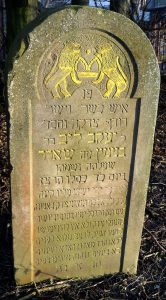
The intact grounded headstone RG0023 (Yaakov Leib Schorr).
An intact and grounded headstone in the new Jewish cemetery in Rohatyn, this late stone includes the full name of the deceased both in an acrostic in its beautiful Hebrew epitaph and separately in Hebrew on the back side of the stone, so no additional research was needed to identify to whom the headstone belongs. No members of the RDRG are currently researching the Schor/Schorr surname, but the group’s founder Dr. Alexander Feller located a clear death record for Jakob Leib Schorr, son of Benjamin and Blima, who died at age 74 on the date listed in the epitaph.
Curiously, the martyr’s list in the Rohatyn Yizkor Book lists both a Yaakov Leib Schorr and a Binyamin Schorr as victims with their families of the Holocaust in Rohatyn. However, there appear to have been several Schorr family lines in and around Rohatyn; the Yizkor Book mentions several other Schorrs in Rohatyn history, plus one has a prominent role in S. Y. Agnon’s semi-fictional story The Bridal Canopy (partially set in Rohatyn), and there are the notorious and perhaps apocryphal stories of the Rohatyn Schorr family linked with the Sabbatians and the followers of Jakob Frank – this Yaakov Leib Schorr likely had no connection to those Schorrs.
Other grounded late headstones on which the full name of the deceased is carved include RG0021: Tzvi Hirsch Reichbach, son of Yechiel Mechel (d. 1936); and RG0022: Moshe Teichmann, son of Shimon (d. 1936).
RL0082: Yaakov Aufrichtig, son of Naftali (d. 1910)
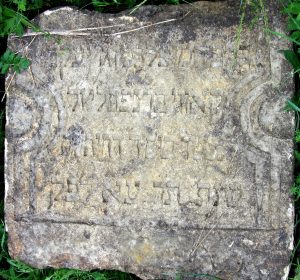
The stone fragment RL0082 (Yaakov Aufrichtig).
Only a much-worn portion of this headstone was recovered in Rohatyn in 2012, with just four lines of the epitaph, but those lines fortunately include the given name and patronymic (Yaakov ben Naftali) of the deceased as well as a death date tied to the Jewish holiday calendar. From this we were able to identify the approximate death date on the Gregorian calendar, and in surviving death records at the Central Archives of Historical Records in Warsaw (AGAD) we found a corresponding record for Jonas Jakób Aufrichtig, who died 21 October 1910 in Rohatyn. The surname Aufrichtig is not mentioned in the Yizkor Book for Rohatyn, but it appears in 1846 property records for Rohatyn and there are members of the RDRG researching that surname and we visited Rohatyn with some family members in 2019, including the old cemetery where this stone likely originated.
RL0085: Shlomo Yosef Bäder, son of Yitzhak (d. 1912)
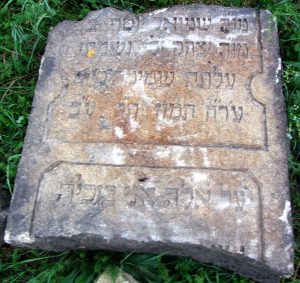
The fragmented headstone RL0085 (Shlomo Yosef Bäder).
Another badly-broken fragment recovered in 2012, this stone includes only five lines from the middle of the original epitaph. The laudatory introduction is missing but fortunately the first surviving line gives the name of the deceased (Shlomo Yosef) and the next gives his father’s name (Yitzhak). The four line gives the date of death as “the day of the new moon of Tammuz [5]672” which enabled us to locate the death record for Samuel Josel Bäder, who died 13 June 1912 in Rohatyn. The Bader/Bäder/Beder surname is researched by members of the RDRG, and several Bader family lines appear in the Rohatyn Yizkor Book, especially in the section on the interwar Zionist youth groups in Rohatyn, as well as among the Holocaust martyrs. Some of those names also appear in late WWII Soviet records of Jewish victims in German-occupied Rohatyn.
RL0070: Juda Schecter (d. 1914)
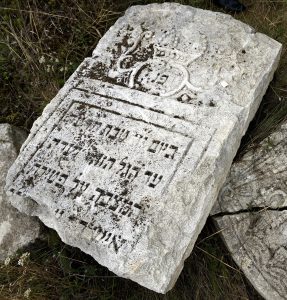
The fragmented headstone RL0070 (probably Juda Schecter).
This headstone fragment, though badly damaged and worn like the stone above, preserves only the symbolic upper part (a crown and vegetation) plus the laudatory introduction; there is no name in the four lines of the epitaph, but fortunately there is a date: 14 Tevet 5674 (about 12 January 1914), which falls within the surviving death records at AGAD. In our research we have found that death dates in the formal records often vary slightly from the dates inscribed on headstones, often a day (or a few) days earlier in the records than on the stones. Here, the records identify a Juda (Yehuda) Schecter who died 11 January 1914 at age 43 in Firlejów (today Lypivka, a village about 13km north of Rohatyn). The only other recorded deaths around that date are a man (Herzel Scheer) who died on 07 January at 86 years old, a boy who died on 14 January at three weeks old, and a woman who died on 15 January. We can’t be certain, because not all deaths inscribed in stone in Rohatyn appear in the death records, but it seems likely that this stone fragment belongs to Juda Schecter. Many of the Schecter men in Rohatyn served as shochtim (ritual slaughterers) for the Rohatyn community, and the Schecter surname is mentioned several times in the Rohatyn Yizkor Book, both among the shochtim and among the men deported to Russia during the first World War; the surname is currently researched by members of the RDRG.
RL0006: Markus Kreisler, son of Abraham (d. 1938), and
RX0221: Sara Kreisler, daughter of Yisrael Yehuda
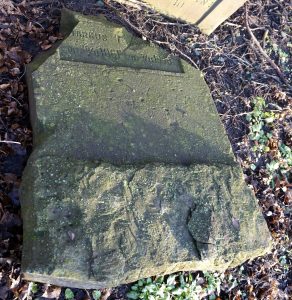
The surviving fragment of stone RL0006 (Markus Kreisler).
These two stones are each interesting by themselves, and may also have a family connection.
Stone RL0006 is a small surviving fragment of what was once a large and very heavy headstone; now only the very bottom of the stone remains lying loose at the foot of other headstones in the new Jewish cemetery of Rohatyn. No Hebrew inscription appears on the visible surface, but part of a Polish-language summary is legible below the jagged fracture line. The entire remaining text reads: MARKUS K[…] ur. 26/II 1861 zm. 27/XI 1938. Though no surname is left, the birth and death dates enabled Dr. Feller to locate the death record of the deceased, naming him as the shopkeeper Markus Kreisler, son of Abraham and Sara Kreisler, who died 26 November 1938 in Rohatyn. We were also able to locate the birth record for Markus, from 26 February 1861 in Rohatyn. The Kreisler/Kreizler surname was well-known in Rohatyn, appears frequently in the Rohatyn Yizkor Book, and is currently researched by members of the RDRG.
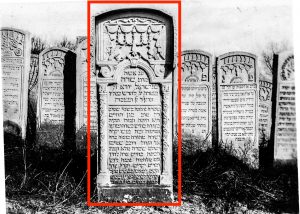
The prewar photo of the missing headstone RX0221 (Sara Kreisler).
Stone RX0221 is missing, known to us only from a prewar photograph by an unknown author of Rohatyn’s old Jewish cemetery, which was provided to us for our research by the Polish collector Tomasz Wiśniewski. In the photo this stone is in the foreground, clear and complete, with an elaborate epitaph. The deceased is named as Sara, daughter of Yisrael Yehuda, died on the 13th of Kislev [5]674 on the Hebrew calendar. We were able to locate her death record identifying her as Sara Kreisler, who died on 11 December 1913 at about age 70 in Rohatyn. It may be only a coincidence, given the common given names and surname, but it seems possible that this Sara Kreisler who was probably born in the 1840s might have been the Sara Kreisler who gave birth to Markus Kreisler in 1861.
Sara’s full epitaph is both beautiful and heart-breaking in its praise of her virtues:
here is buried a woman
Sara
daughter of Yisrael Yehuda, blessed be his memory
died on the 13th of the month of Kislev
[5]674 according to the short calendar, may her soul be bound in the bond of (eternal) life
her beauty is in the inheritance of the name of heaven
the greatness of kindness in the garden of life
she was perfect and pious
while she was still alive, pure and chaste
perfect, innocent, a dear soul
honest, bright as the morning star(?)
great in heaven …
he will pay in full
she walked a narrow path in life
and also … gave to the poor
dear things, valuables
may the Lord reward her in heaven
her memory, blessed on earth and in heaven
may it burn forever among the living
Readers of Hebrew will also note that the first letters of each line of the epitaph form an acrostic giving her name and patronymic: Sara, daughter of Yisrael Yehuda, blessed be his memory (the last phrase in the form of an abbreviation).
The Work Continues
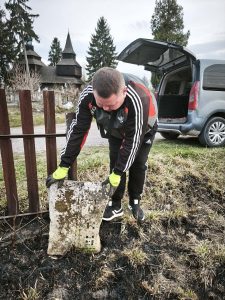
Stone fragment RL0059 recovered in Rohatyn in March 2026. Photo courtesy of Tetiana Petriv.
As seen from the examples here, we have worked our way through documenting the small number of grounded headstones in Rohatyn, and all of the stones we could extract from prewar photographs of the Jewish cemeteries, as well as a hundred stones recovered from outside the cemeteries before we engaged with the burial sites and then through our own project in 2011 and part of 2012. We are currently processing (formatting photos, transcribing, and translating) stones from 2012 and after, in a new batch of 100 loose stones. We anticipate that the documentation work will continue through 2026 and probably beyond, as there remain roughly 320 more headstones, mostly fragments, to add to the database. As we work we typically encounter a few duplications, which leave gaps in the stone ID numbering; sometimes that gives us an opportunity to document recently-recovered stones, such as one which was abandoned by mistake at the perimeter fence of the WWI soldier’s cemetery in Rohatyn just two months ago.
Because we work in batches for efficiency, and most of the work on the database is volunteer, sometimes it may seem as if the project is stalled. Please be patient; we are still growing the record of the prewar Jewish community of Rohatyn and environs “behind the screens”. As always, we express our gratitude to Tetiana Fedoriv and Vasyl Yuzyshyn for their steady effort on the Rohatyn database, and to Sasha Nazar of the Sholem Aleichem Jewish Cultural Society of Lviv and the many other volunteers who have led or aided Jewish headstone recovery work in Rohatyn and across western Ukraine.
 Except where noted, all images on this page are licensed under a Creative Commons Attribution-Share Alike 4.0 International license by authors Marla Raucher Osborn and Jay Osborn of Rohatyn Jewish Heritage.