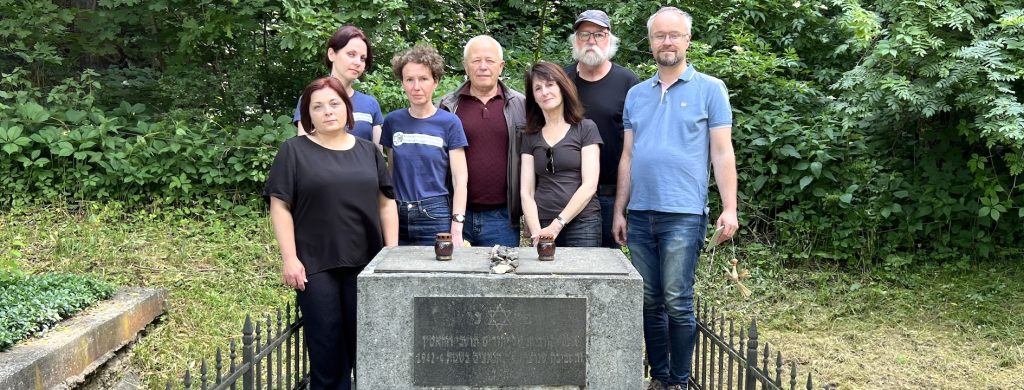
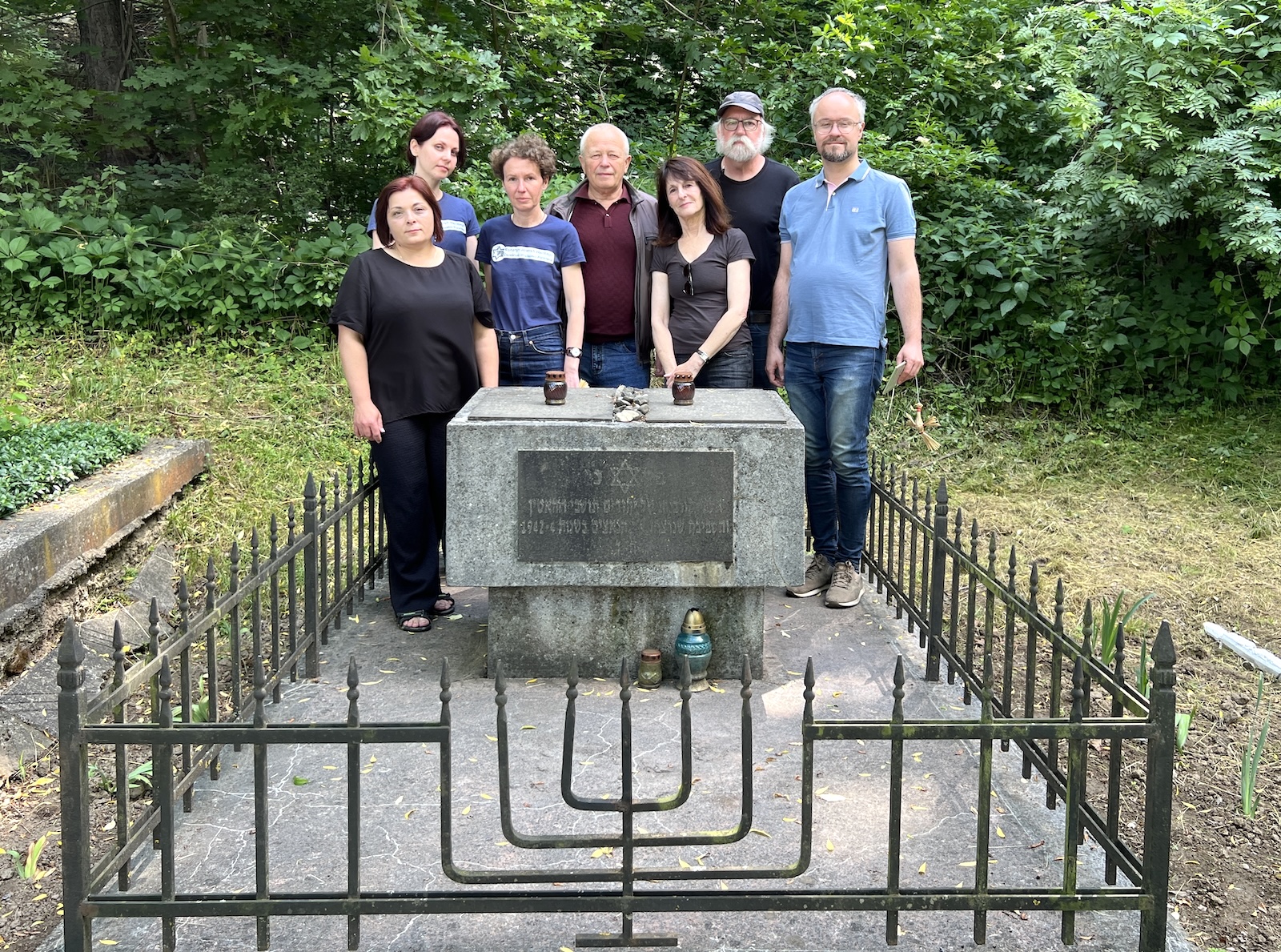
Our group at the memorial monument.
Today Jay and I visited Rohatyn with friends from Ternopil, Zbarazh, Lviv, and Rohatyn to commemorate together 83 years since the final liquidation of the wartime Jewish ghetto.
 Ця стаття також доступна українською.
Standing before the memorial monument at the north mass grave site – the final resting place of more than 3000 Jewish victims from Rohatyn and the surrounding region, including Burshtyn, Khodoriv, and Bukachivtsi – I read the following speech on behalf of Rohatyn’s Jewish families who could not be here at this time:
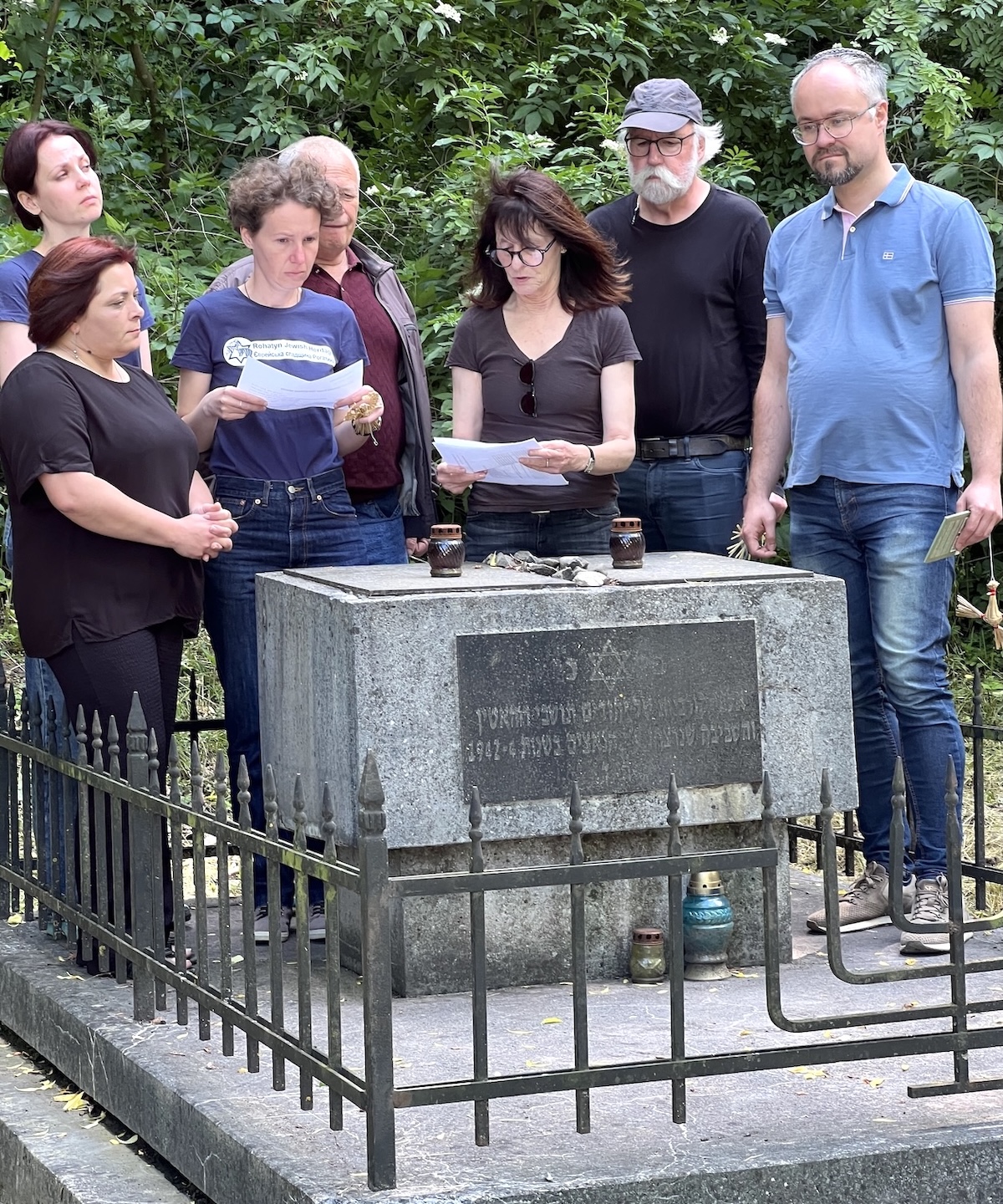
Reading the history and the prayer.
Today we stand witness to the memory of the more than 3,000 Jewish men, women, and children who were executed and buried together at this site north of town center, commonly known as the vodokanal. We are here to remember that 83 years ago today, the final liquidation of the Rohatyn Jewish ghetto began: a series of organized executions and burials at this site starting on June 6, 1943 and continuing for two or three days, taking the lives of several thousand Jews from the Rohatyn district. Jewish and Ukrainian testimonies and memoirs say that interments continued here afterward, burying Jewish survivors who had escaped the liquidation but were later caught and killed, until the end of the occupation.
When the ghetto was liquidated 83 years ago, most of the Jewish individuals and families originally from Rohatyn – our families – had already been murdered. Those still alive in the reduced ghetto space were mostly Jews forcibly brought to Rohatyn from surrounding towns and villages; in total they numbered more than 3000. Some of these Jews anticipated the fate that awaited them and went into hiding in bunkers clandestinely built inside and outside the ghetto. Most did not succeed in eluding capture and were shot upon discovery. A small, unknown number resisted the liquidation with fortifications and weapons smuggled into the ghetto, too few to withstand the onslaught during those days.
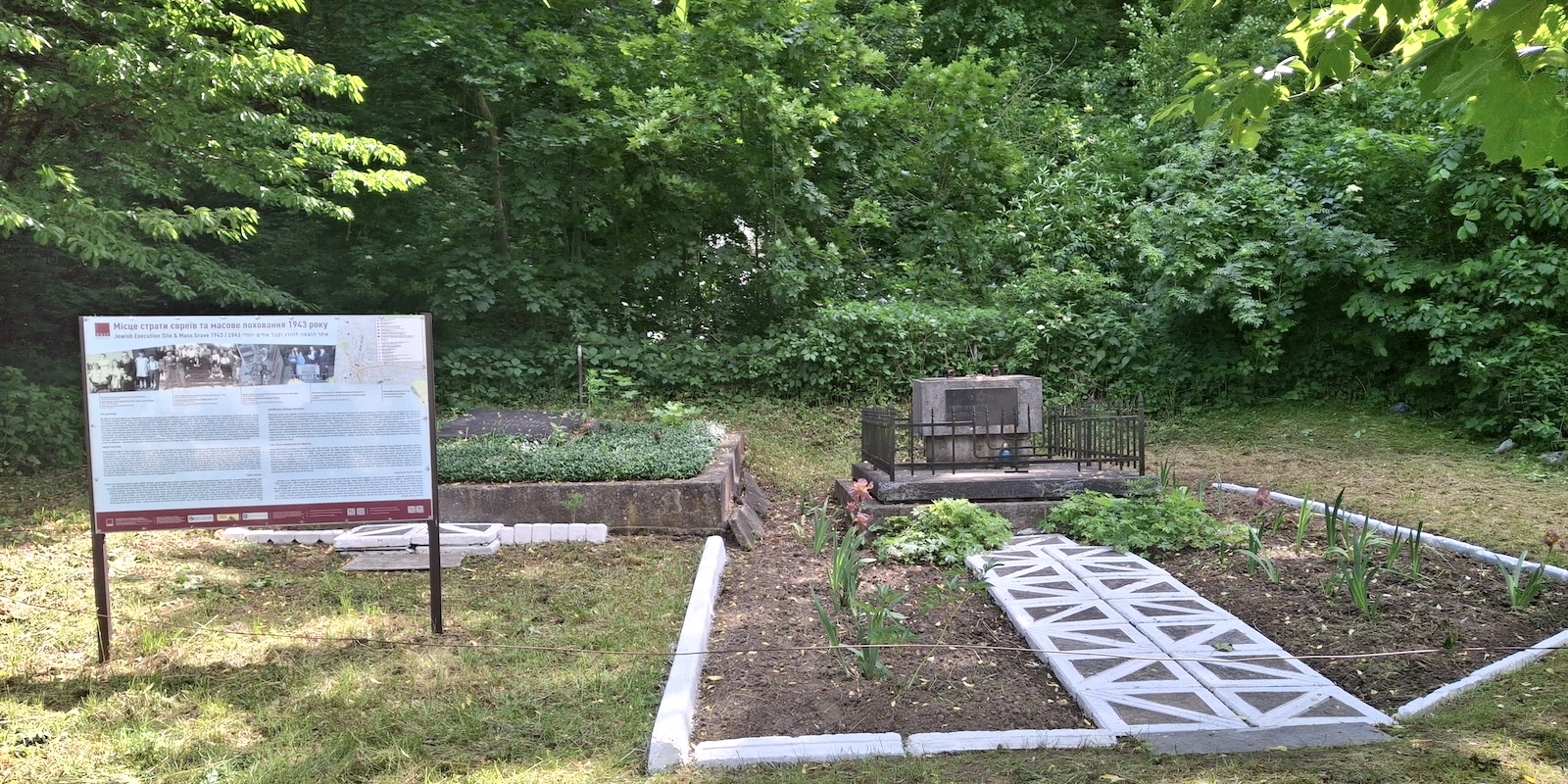
The north mass grave site today.
We know from Jewish and Ukrainian testimonies that ghetto inhabitants were marched to the brickworks – the vodokanal area where we stand today – and shot on planks laid over deep trenches, dug days before; there were only a few witnesses. It is painful 83 years later to imagine the violence of those days.
So it is not difficult to understand that for many Rohatyn Jewish descendants it is still too painful to come today to Rohatyn. We are immensely grateful that some Rohatyn Jewish survivors and descendants came to Rohatyn more than twenty-five years ago to erect this monument as a memorial to the lost, together with the city administration of Rohatyn, local historians and townspeople, and religious leaders of all faiths. By our coming together today to pray, to reflect, and to honor the memory of the Jewish victims, we build bridges and hope to lessen cross-generational pain. By our presence here together, by our solidarity on this date, at this site, we send a message of tolerance and forgiveness, of remembrance and compassion. On behalf of my Rohatyn families and Rohatyn Jewish descendants living abroad, I thank you for coming and joining me in remembering. May the memory of the victims bind us together. Baruch Dayan HaEmet.
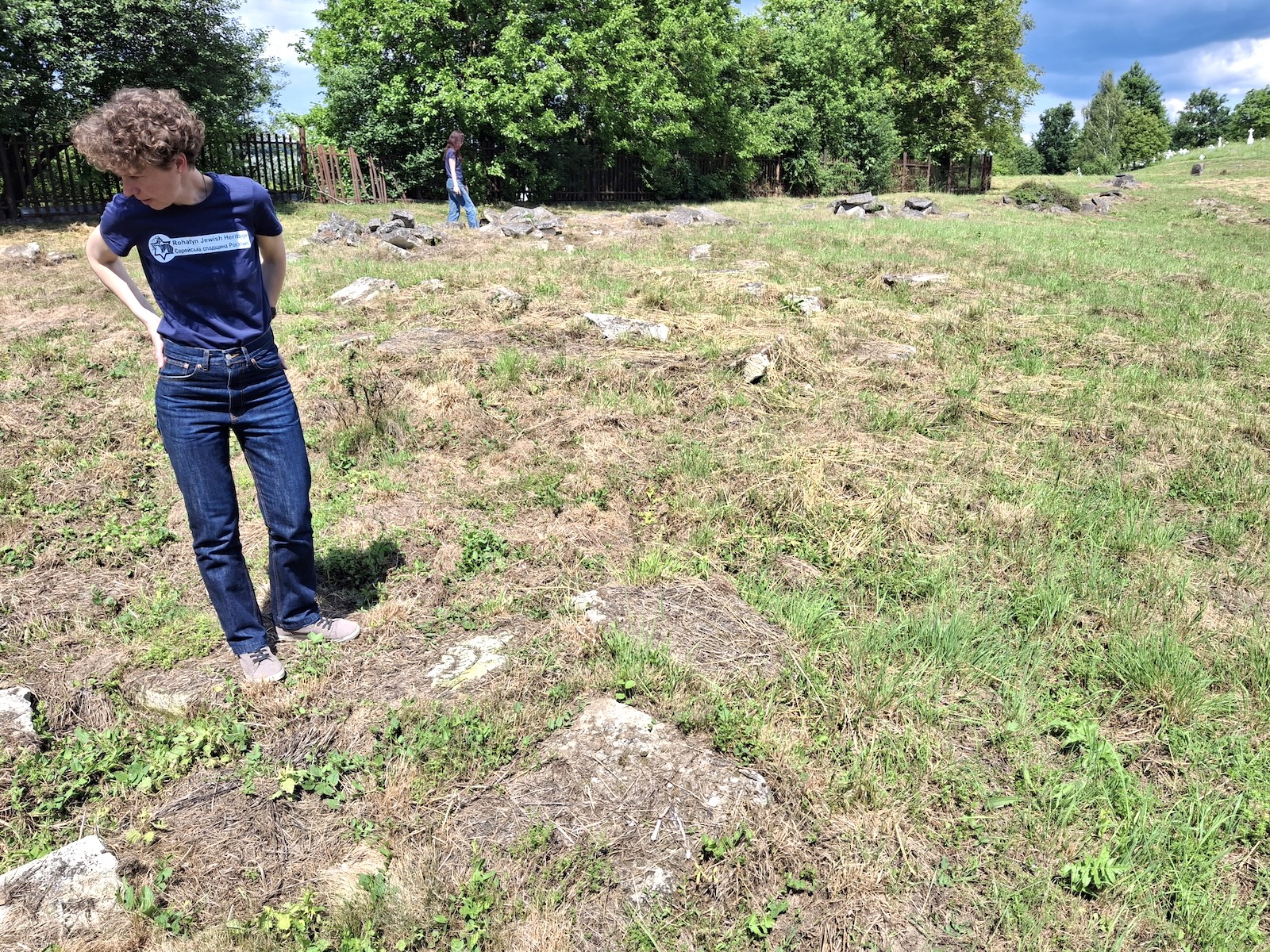
Tania (foreground) and Ira in the old Jewish cemetery later in the day.
Our Ukrainian friend Tania Fedoriv – historian, researcher, and author on the Jewish history of her hometown of Zbarazh (Ternopil oblast) and caretaker of her city’s new Jewish cemetery – then read the prayer El Malei Rachamim (אֵל מָלֵא רַחֲמִים, “God, full of mercy”) in Hebrew. Alongside us were Iryna Nebesna, Ternopil journalist and heritage advocate, and Wito Nadaszkiewicz, Lviv attorney and current CEO for Rohatyn Jewish Heritage. Tania, Ira, and Wito have been to Rohatyn many times over the years, including at this site in June 2025 as well as in March of this year at the south mass grave site on the anniversary of the wartime executions there, and all three continue to support us and others in many heritage research and preservation projects across western Ukraine.
Also joining us was Ihor Zalypko, lead engineer at Rohatyn’s vodokanal site (behind which the north mass grave is situated), who for five summers now has also been helping us by maintaining the old Jewish cemetery in Rohatyn and both Holocaust mass graves, this one included. Ihor has joined us several times at past commemorations including in 2024.
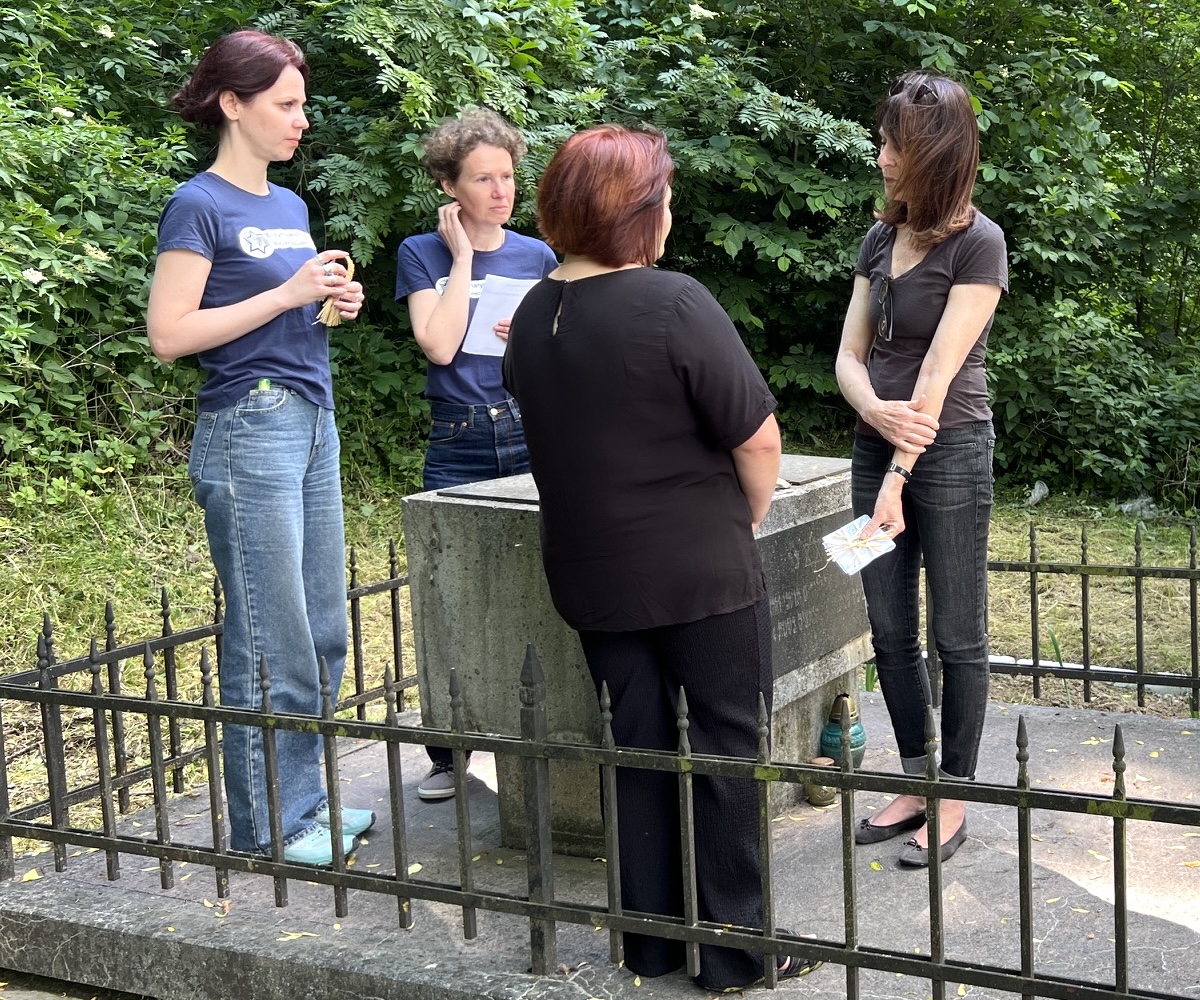
Talking with Tetiana Petriv after the ceremony.
We were also very pleased that Tetiana Petriv from the city’s 17th century UNESCO-recognized Holy Spirit church was able to join us at the commemoration. Tetiana has been a long-time friend and heritage advocate, and was present with us in June 2023 for the 80th memorial ceremony of remembrance at the north mass grave. Earlier this year, Tetiana found an abandoned Jewish headstone fragment at the WWI Austro-Hungarian soldiers’ cemetery adjacent to the church, and a few days later, she and her brother-in-law Bohdan Kryven (Богдан Кривень) safely transported the fragment back to where it belongs at Rohatyn’s old Jewish cemetery. This was not the first time Tetiana assisted us in Rohatyn Jewish heritage recovery: in 2021 a Jewish headstone fragment was found at the Rohatyn Fire Department, and during our next visit she brought us to meet the head of the facility and we together transported the fragment back to the old cemetery.
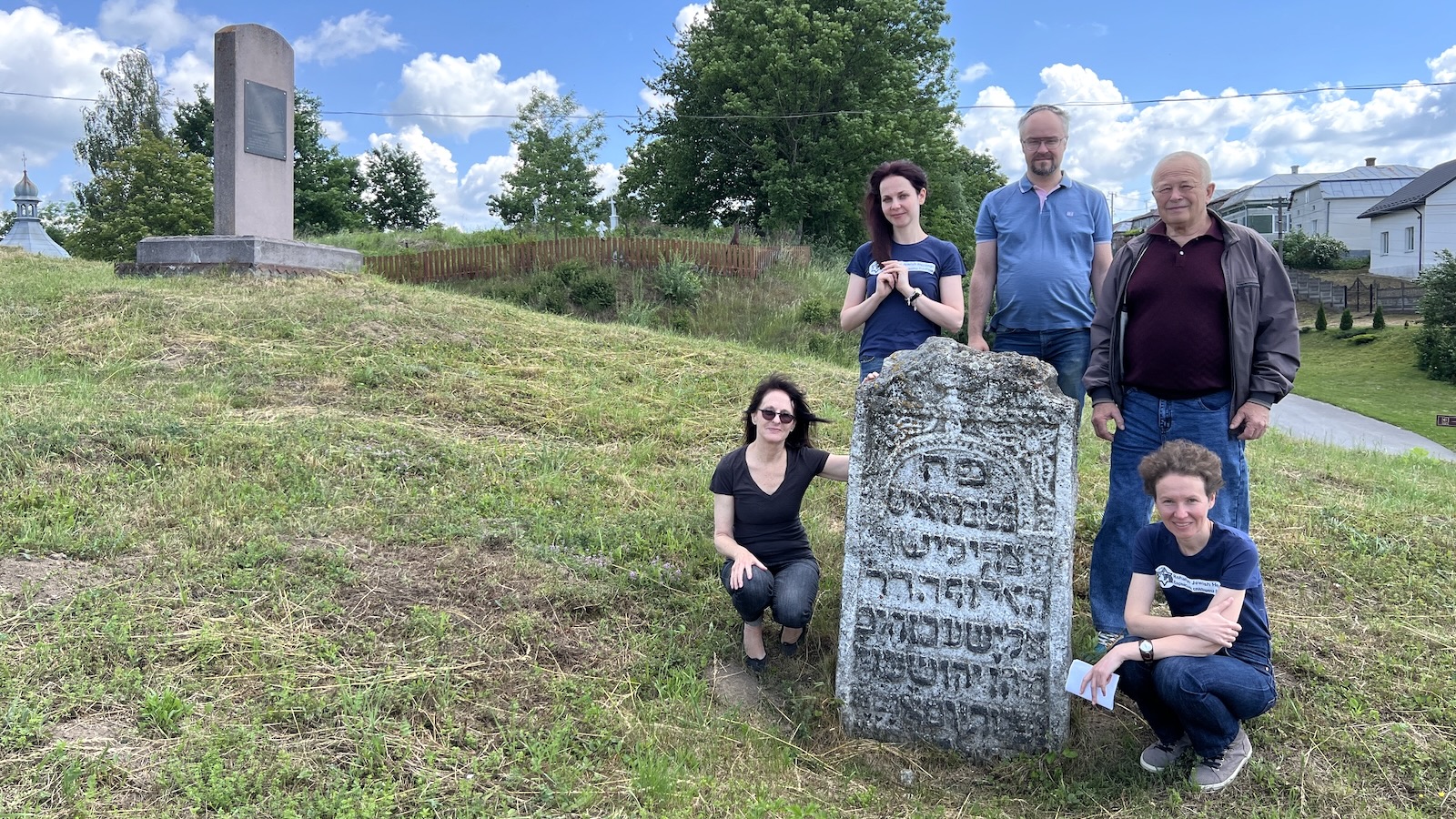
With Ihor in the old cemetery in the morning.
As always, Jay and I are immensely grateful to Rohatyn residents like Tetiana and Bohdan for their continued support in recovering Jewish memory, especially while the Russian war on Ukraine continues relentlessly, now in its fifth bloody year. It is thanks to Rohatyn citizens such as Tetiana and Bohdan that this kind of important heritage work continues, even without Jay and I being present.
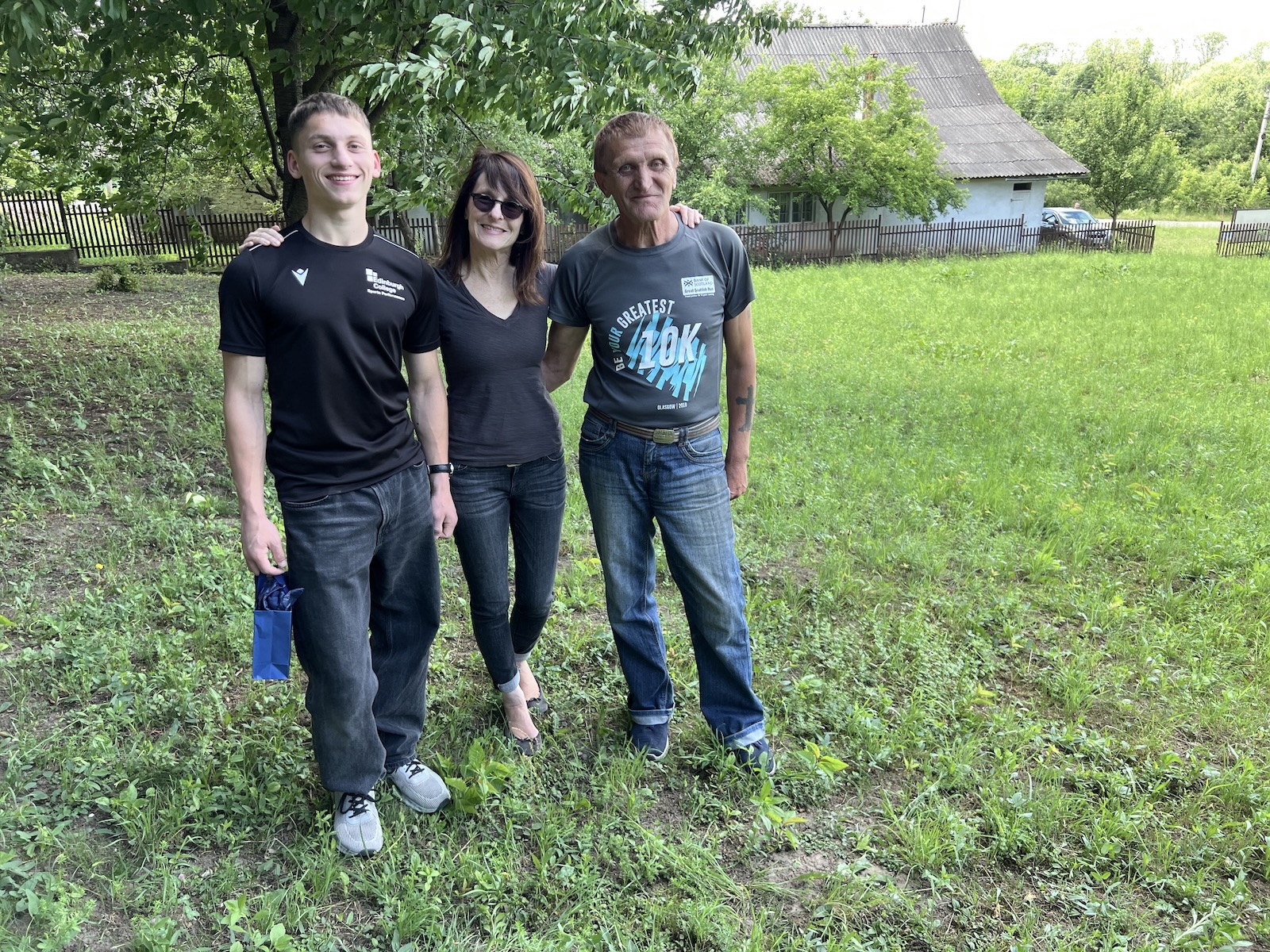
Vasyl Yurkiv and his son Artur in the new cemetery today.
Following the prayer at the north mass grave memorial, we visited the south mass grave site as well as Rohatyn’s two Jewish cemeteries, taking photos and checking on the sites’ overall condition. These historic burial sites have for several years now been maintained for us by Rohatyn residents Ihor Zalypko and Vasyl Yurkiv, and we are especially pleased that they have both agreed to continue their work through next year, their health, family, and wartime challenges permitting. Both men regularly monitor the sites to alert us for any needed maintenance or repairs and from late spring to late fall, they mow and clear wild vegetation.
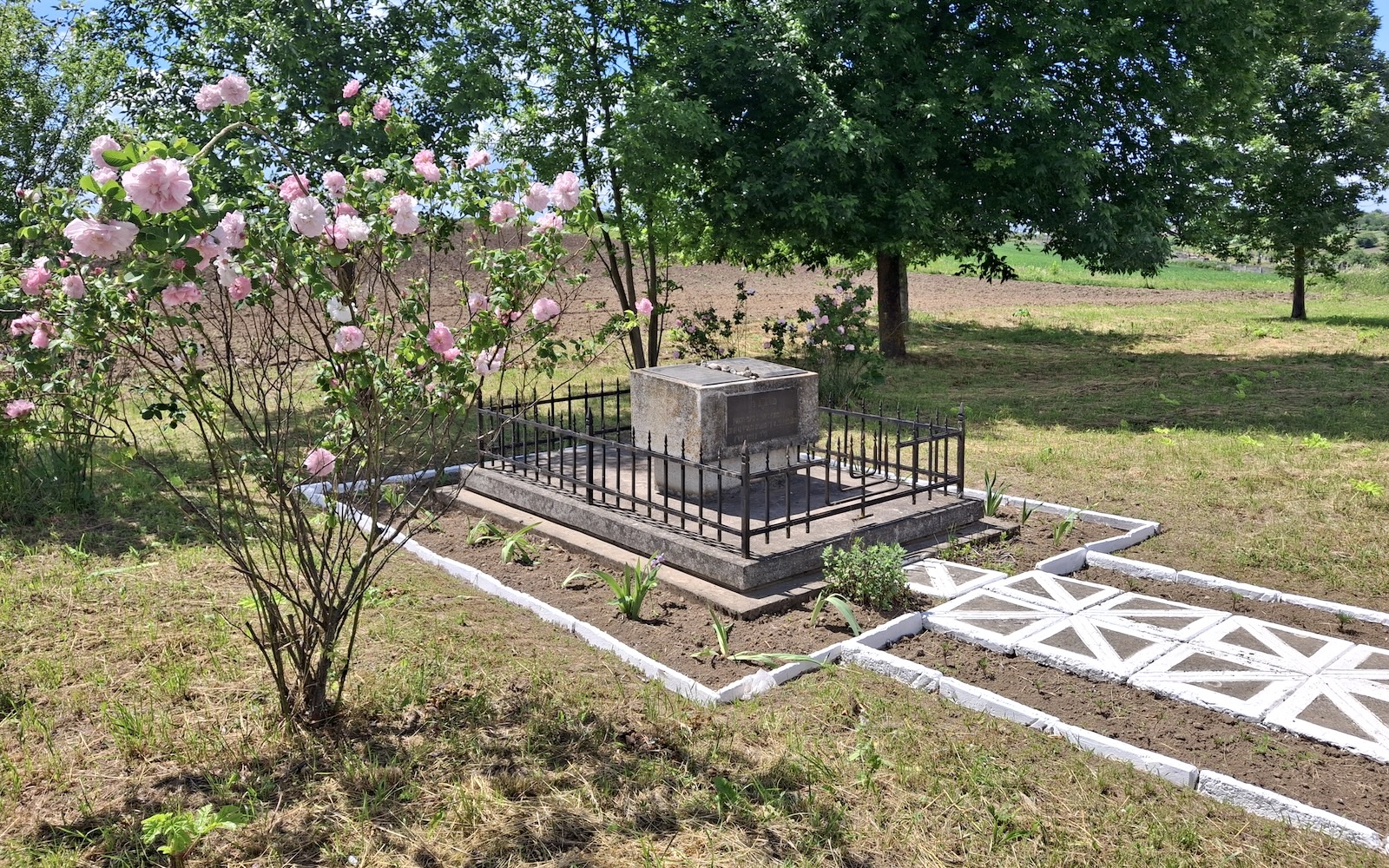
The south mass grave site in bloom today.
As we did when we met with Ihor and Vasyl last summer, on this visit we prepaid both men for their anticipated 2027 work (mowing and light repairs to memorials and fences), and included some additional funds for tool maintenance and small contingencies. This year we also left extra funds with Ihor to make repairs to portions of the concrete wall surrounding the old Jewish cemetery, which has been decaying and crumbling particularly near the entrance to the site, and to two of the mass grave memorial monuments.
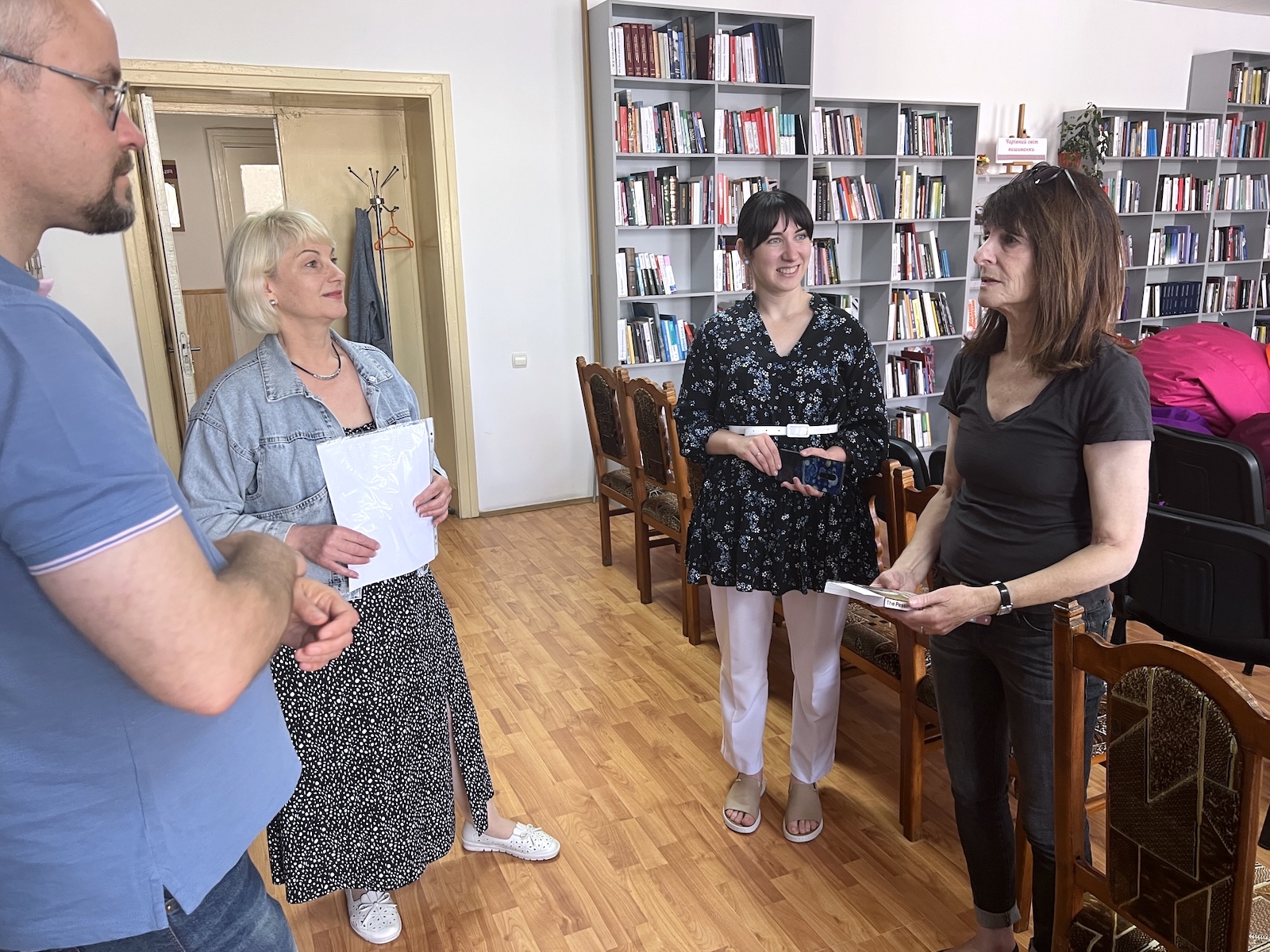
With Lida and Zoriana at the library.
We are also pleased to report that both old and new cemeteries and north and south wartime mass graves have already had their first round of clearing for 2026; that work will continue into autumn.
Our group then made a brief visit to our friends at the Rohatyn public library to thank them for their continued support and to make a personal donation for the purchase of library books for the coming school year, important now that book funds are critically constrained because of the war. Since 2011, the librarians have warmly welcomed us and have continued to create opportunities for us to engage in two-way exchanges with Rohatyn residents, educators, and students, even during wartime.
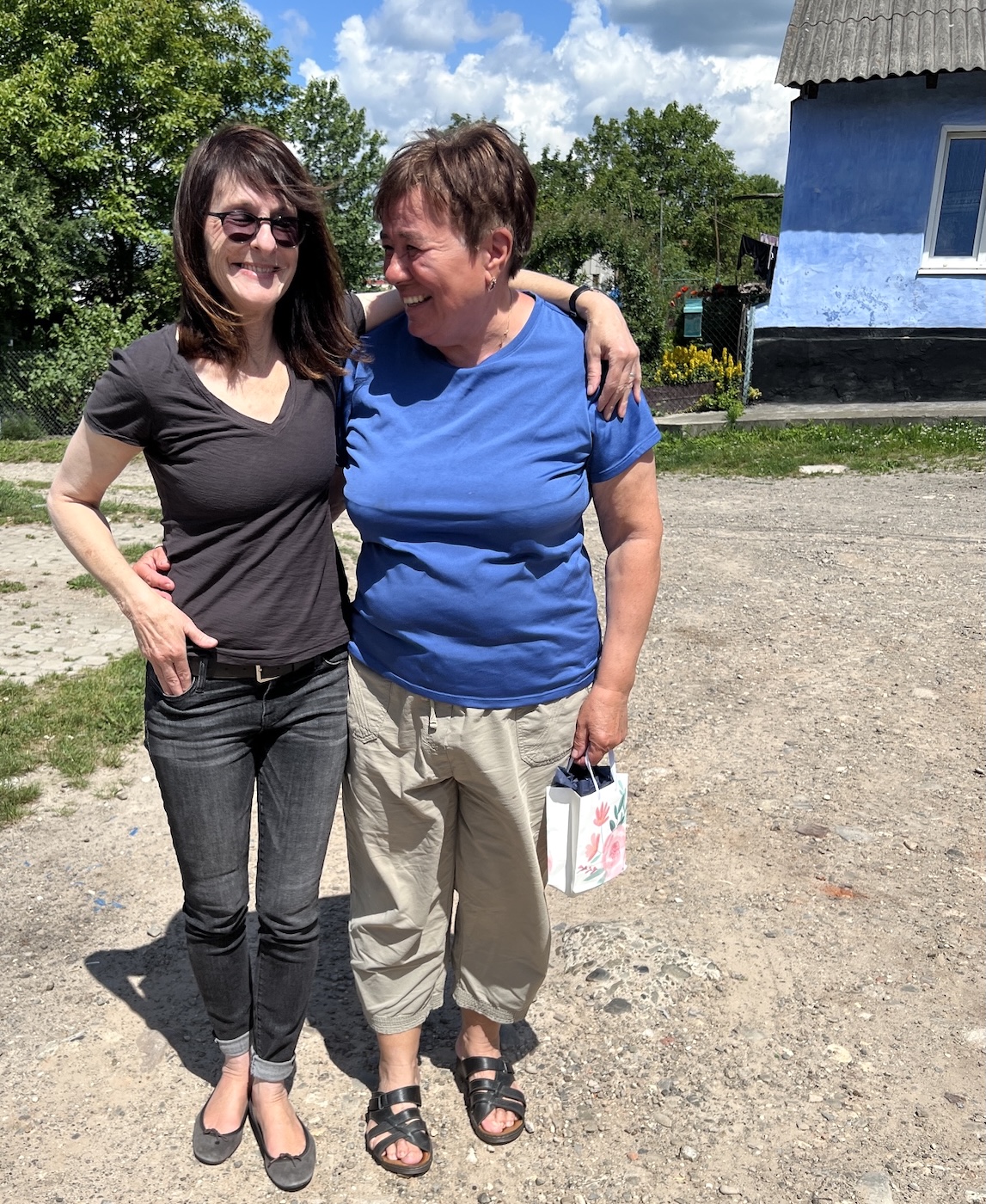
With Hanna on Valova Street.
From the library we walked a few dozen meters to Valova Street where my Horn family of Rohatyn lived for generations and where my grandmother was born. Before the Holocaust and especially in the earliest years, the street had been in a core part of the Jewish quarter; it was the site of the Great Synagogue, destroyed in WWI, rebuilt, and destroyed again in WWII. Noticing the door open to the large building that was formerly the Beit Midrash, we went in to see if the mezuzah trace we found in a door frame back in 2021 was still present – it is. As we exited, our dear friend Hanna Hryvnak exited her home, one of the last pre-WWI houses still standing in Rohatyn. Hanna is one of our oldest friends, having met back in 2011 during one of our first walks along Valova Street, guided by the late Mikhailo Vorobets.
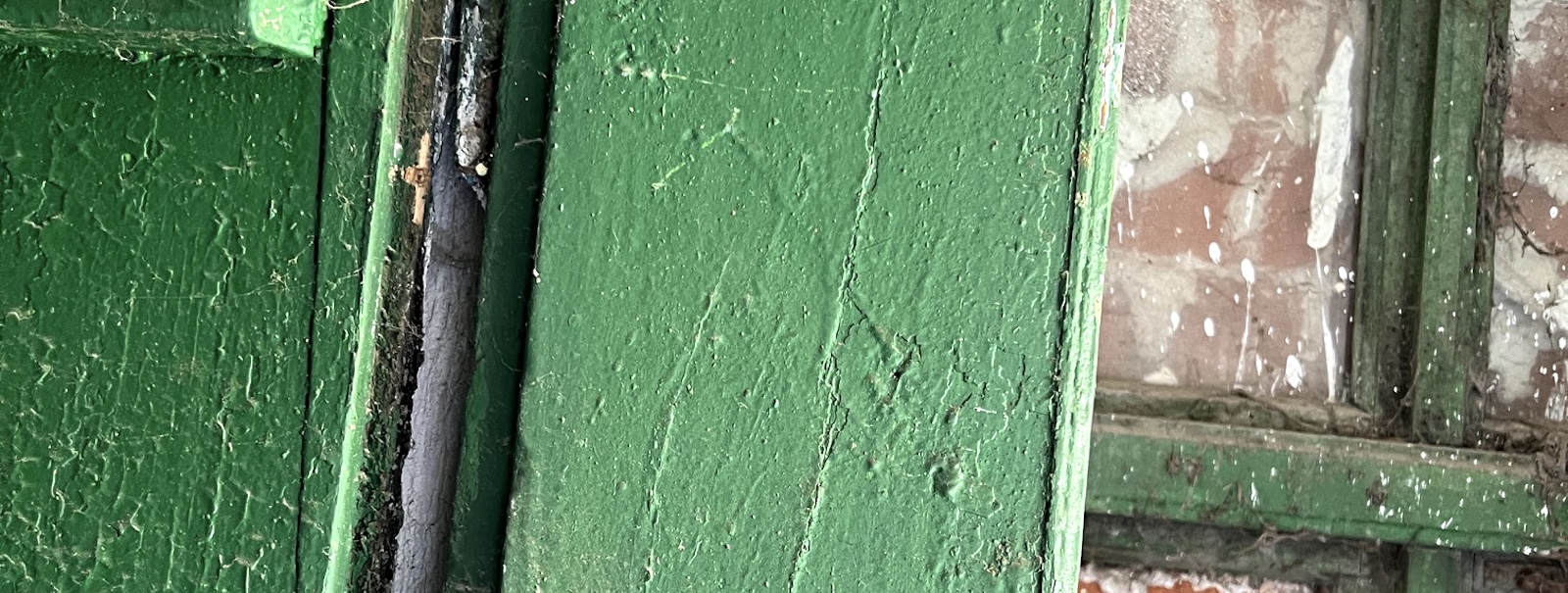
The mezuzah trace on the door frame of the former beit midrash.
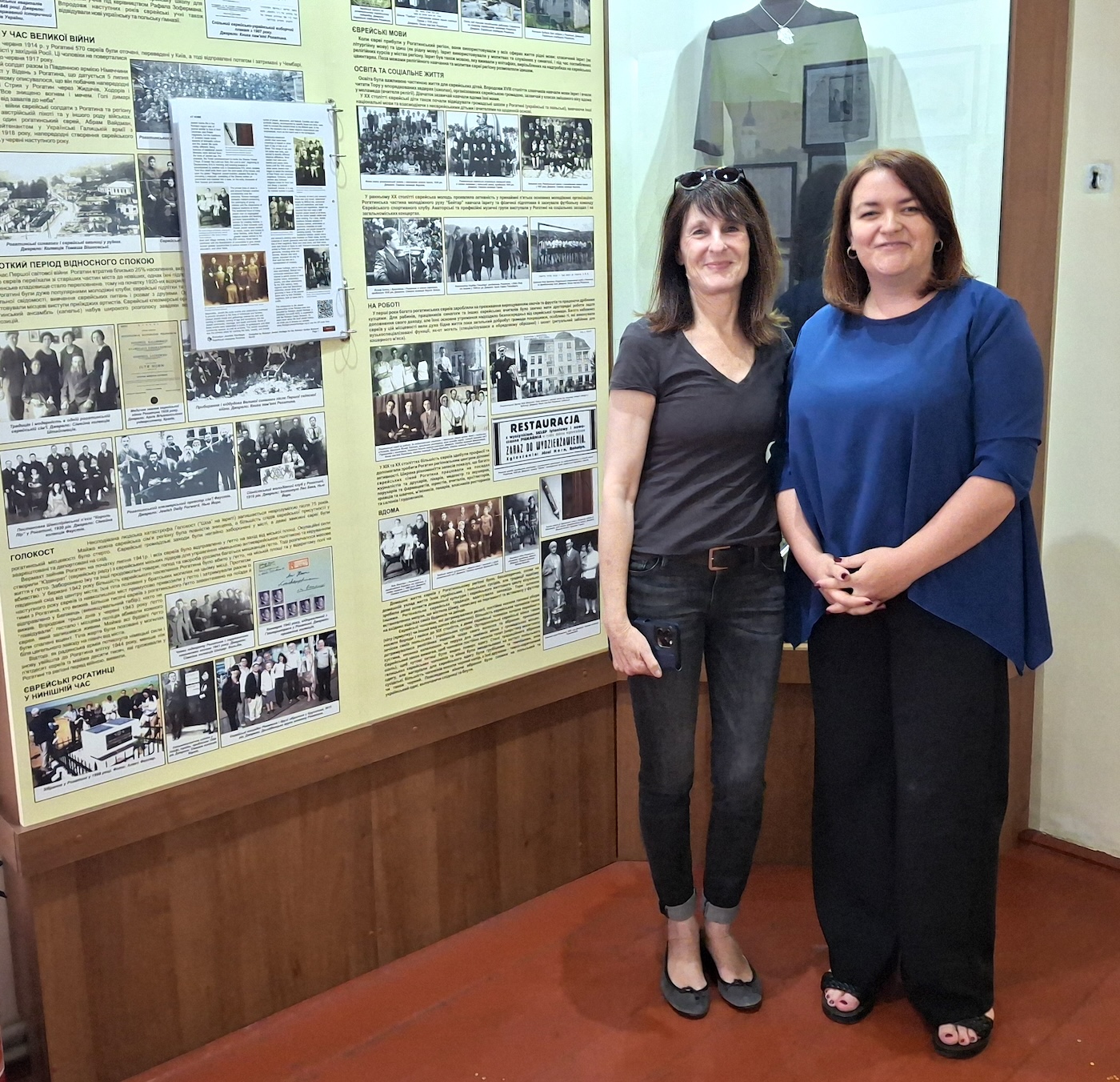
With Olha in front of the Jewish history section of the museum.
We ended our day at the Opillya local history museum in Rohatyn, meeting with its director, Olha Blaha, and its staff artist Roman Yasinskiy. Olha warmly welcomed our group, and guided those in the group who were visiting for the first time. This important local history museum houses a dense collection of artifacts and historical memorabilia, and includes a room with a small permanent exhibition of Rohatyn’s prewar Jewish community, which was the result of many months of collaboration between Rohatyn Jewish Heritage and the museum staff, including with Olha in 2017-2018.
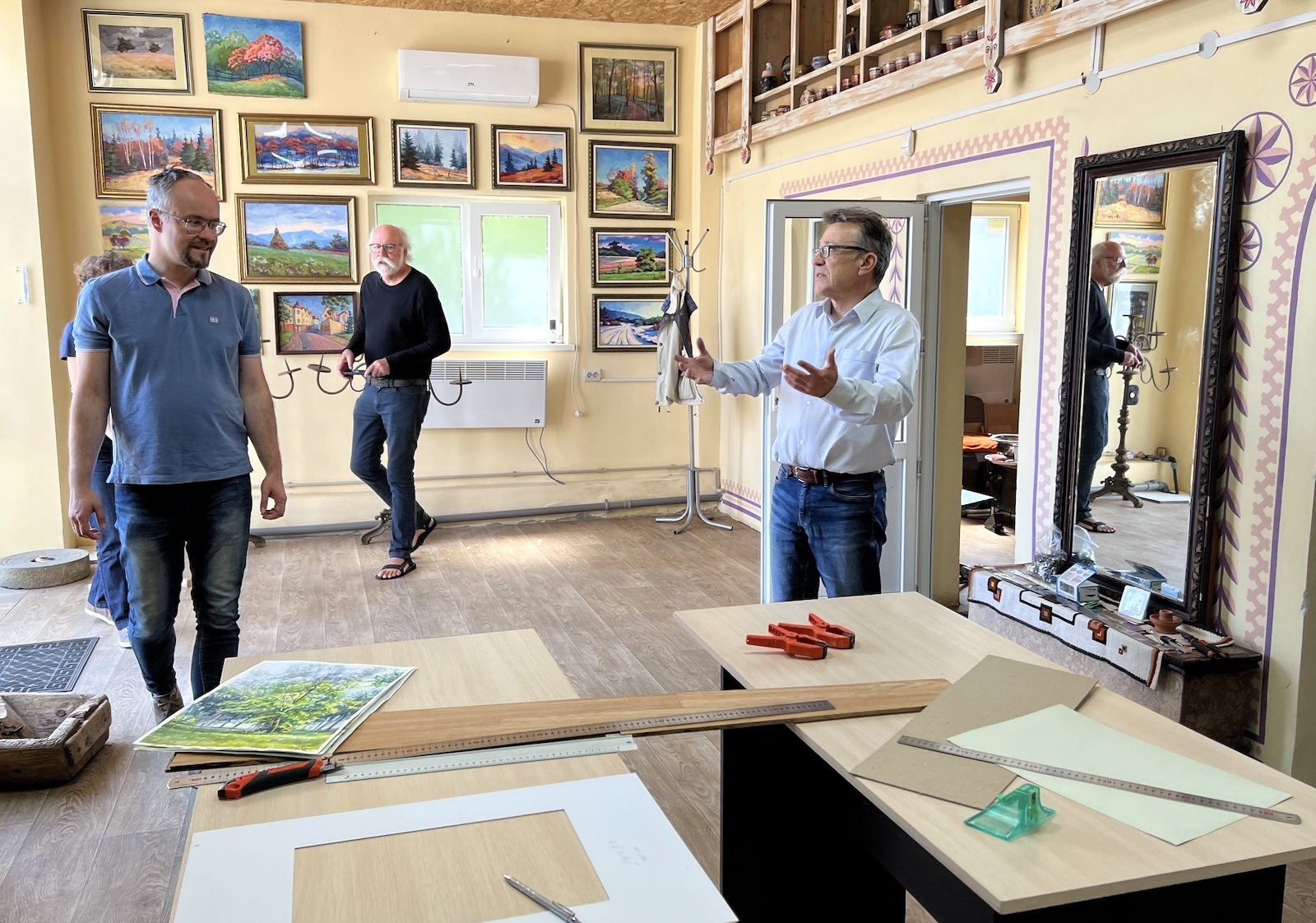
Roman in the museum’s ceramics studio.
While Jay and I are sad that we are only making a single visit to Rohatyn this year compared to dozens in prior years, we are glad to have been able to make this trip to Ukraine and grateful that our connections with friends and colleagues in Rohatyn remain strong.
 Except where noted, all images on this page are licensed under a Creative Commons Attribution-Share Alike 4.0 International license by authors Marla Raucher Osborn and Jay Osborn of Rohatyn Jewish Heritage.