 This is a descriptive annual report for Rohatyn Jewish Heritage (RJH) covering the calendar year 2025, representing our ninth consecutive year of operation as a volunteer-led non-profit NGO in Ukraine. As in past years, this report summarizes our project progress and events together with an outline of our NGO finances.
 Ця стаття також доступна українською.
This was the first year of our NGO’s operation in which Marla and I were present in western Ukraine for only a short visit of a couple of weeks; we made only a single visit to Rohatyn in person this year. Management of the NGO was conducted by us remotely, by our NGO’s CEO and attorney from Lviv, and with volunteer support of a small number of friends in Lviv and the region. Because of the ongoing Russian war of aggression in Ukraine, now in its fourth continuous year since the full-scale invasion, manpower and other materials resources to continue our work are in short supply, and this year our financial support from donors fell off significantly as well.
See our report for 2024 for comparison (prior years’ reports are also accessible in the news section of this website). Many sections of this review are hyperlinked to pages with more information, on or off of our website.
CLEARING AND CARE OF THE JEWISH CEMETERIES AND MASS GRAVE SITES
For a third full year, all of the care and maintenance of the Jewish burial sites in Rohatyn was managed for us by two local men working for hire. We renewed the working relationship again this year with the same men and they served our needs well throughout the vegetation growing season, from mid-spring to mid-autumn.
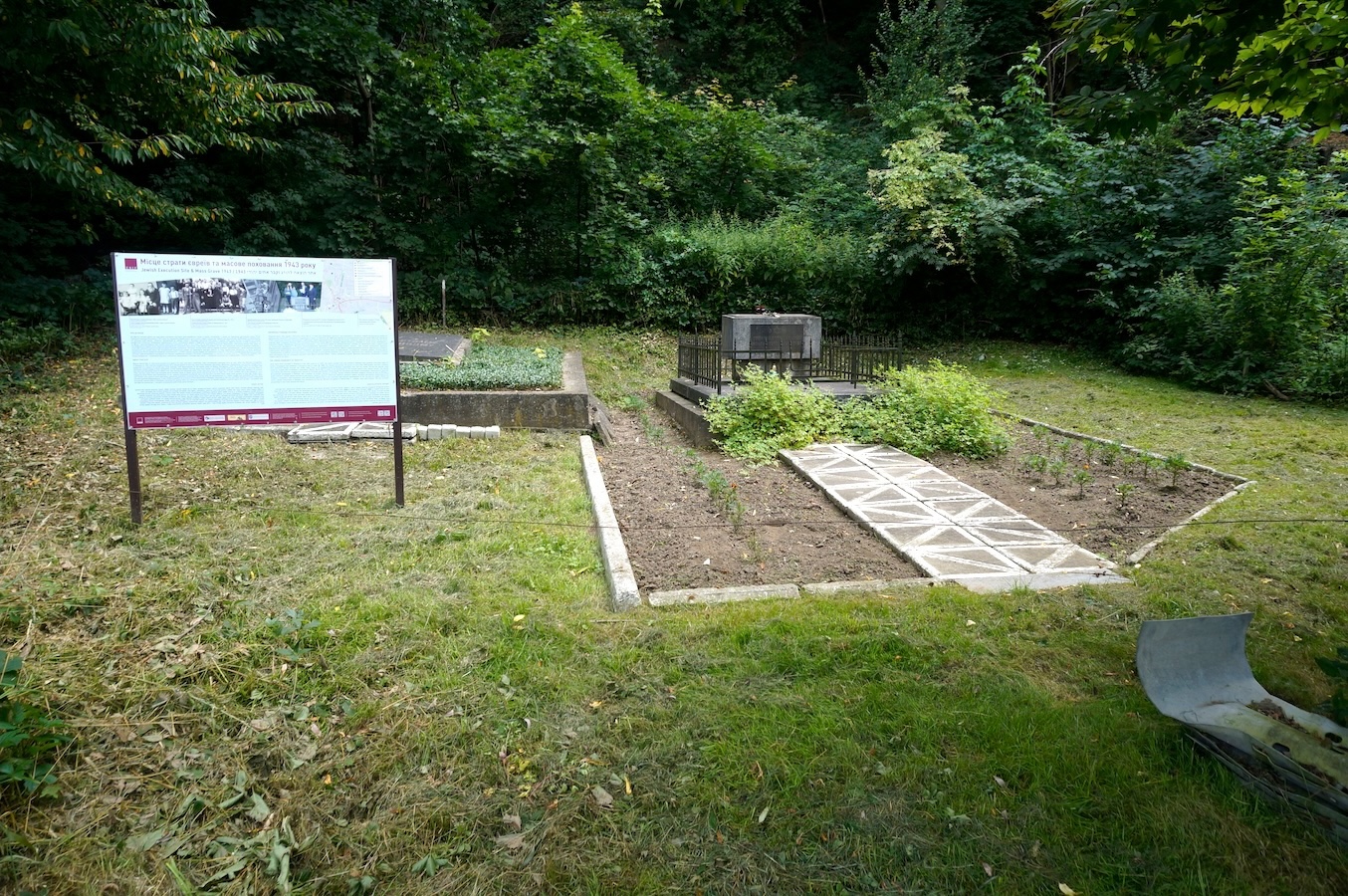
The north mass grave site in early August of this year. Photo © RJH.
Our news report from the end of October records the details of this year’s effort, which included as usual cutting and removal of dead tree branches at the sites. As usual, during the season the men send us a number of photos of the four Jewish burial sites in Rohatyn (two cemeteries and two mass graves) so we can follow the progress from afar. We are grateful to both Ihor Zalypko and Vasyl Yurkiv for their hard work again this year, and we are especially pleased that they have both agreed to continue this work again in 2026 provided their health permits them to carry the heavy effort. Both men regularly monitor the sites to alert us for any needed maintenance or repairs, and through our friend and colleague Vasyl Yuzyshyn we are able to respond and direct the work.
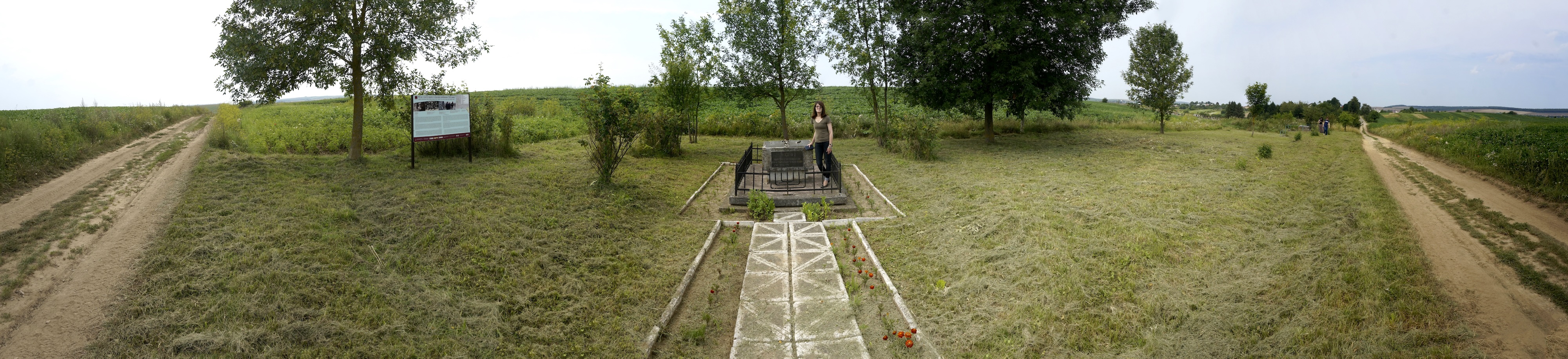
A panorama of the south mass grave site in Rohatyn in August. Photo © RJH.
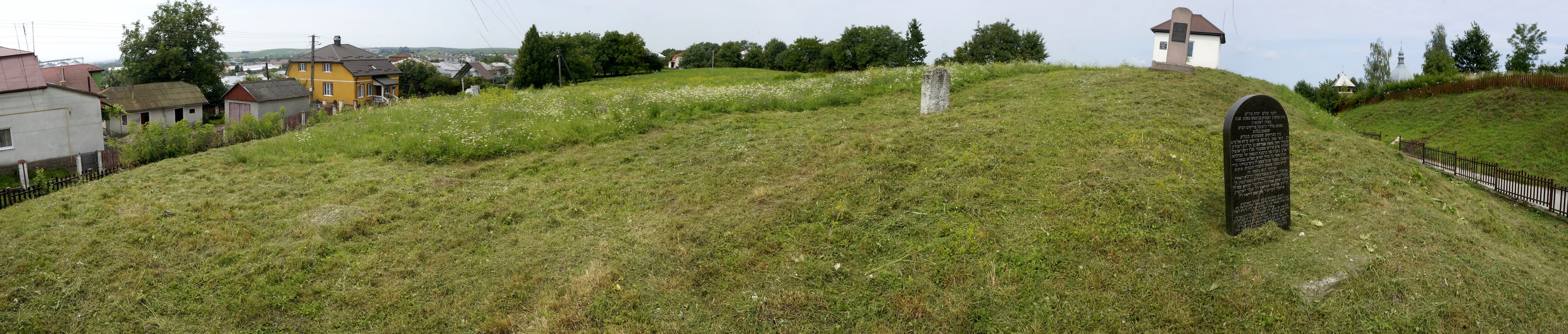
A panorama of Rohatyn’s old Jewish cemetery in August. Photo © RJH.
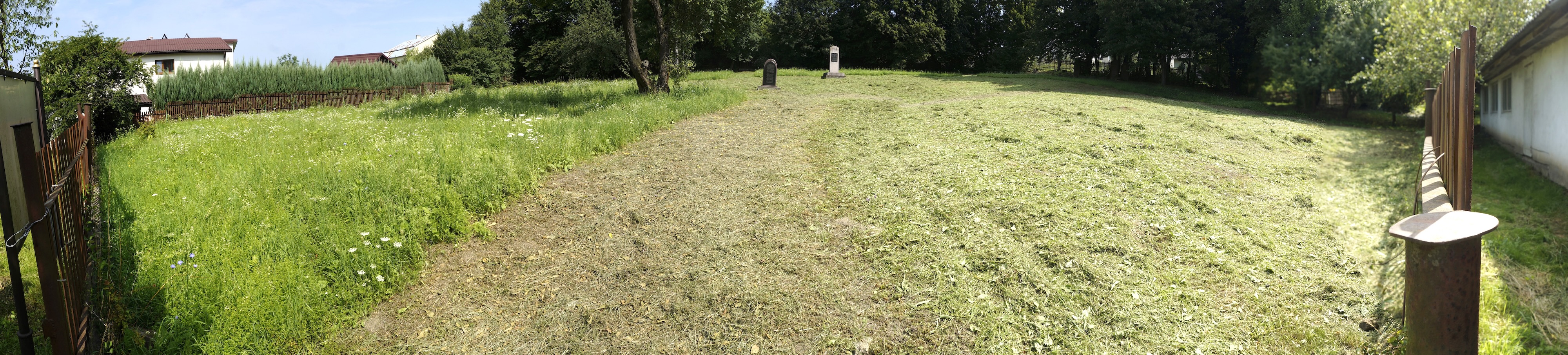
A panorama of Rohatyn’s new Jewish cemetery in August. Photo © RJH.

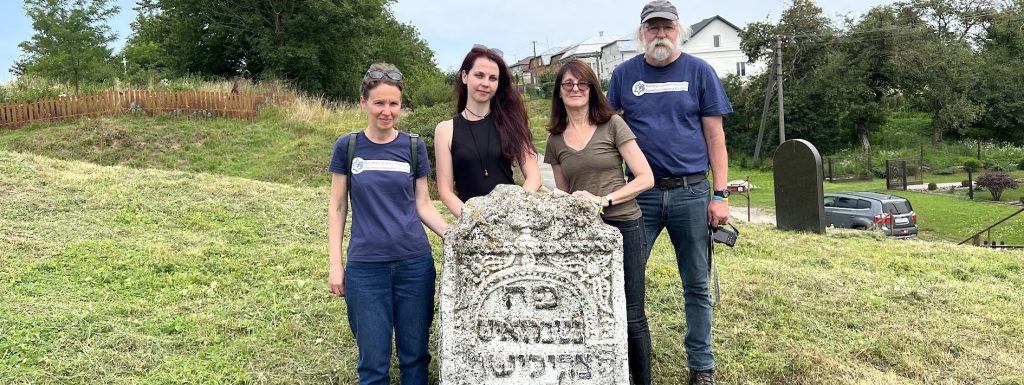
With Tania and Ira in Rohatyn’s old Jewish cemetery. Photo © RJH.
Again this past year, no Jewish headstones were recovered from areas of town outside the two Jewish cemeteries. Although the frequency of headstone discoveries and recoveries has always fluctuated year over year since 2011, we believe the absence of new discoveries in the past two years is another change brought by the ongoing war, as both the City and private property owners are postponing the kinds of projects which reveal repurposed headstones. We still have many friends in Rohatyn who have notified us of discovered stones in past years, so we remain confident that when stones are found, we will hear and be able to respond.
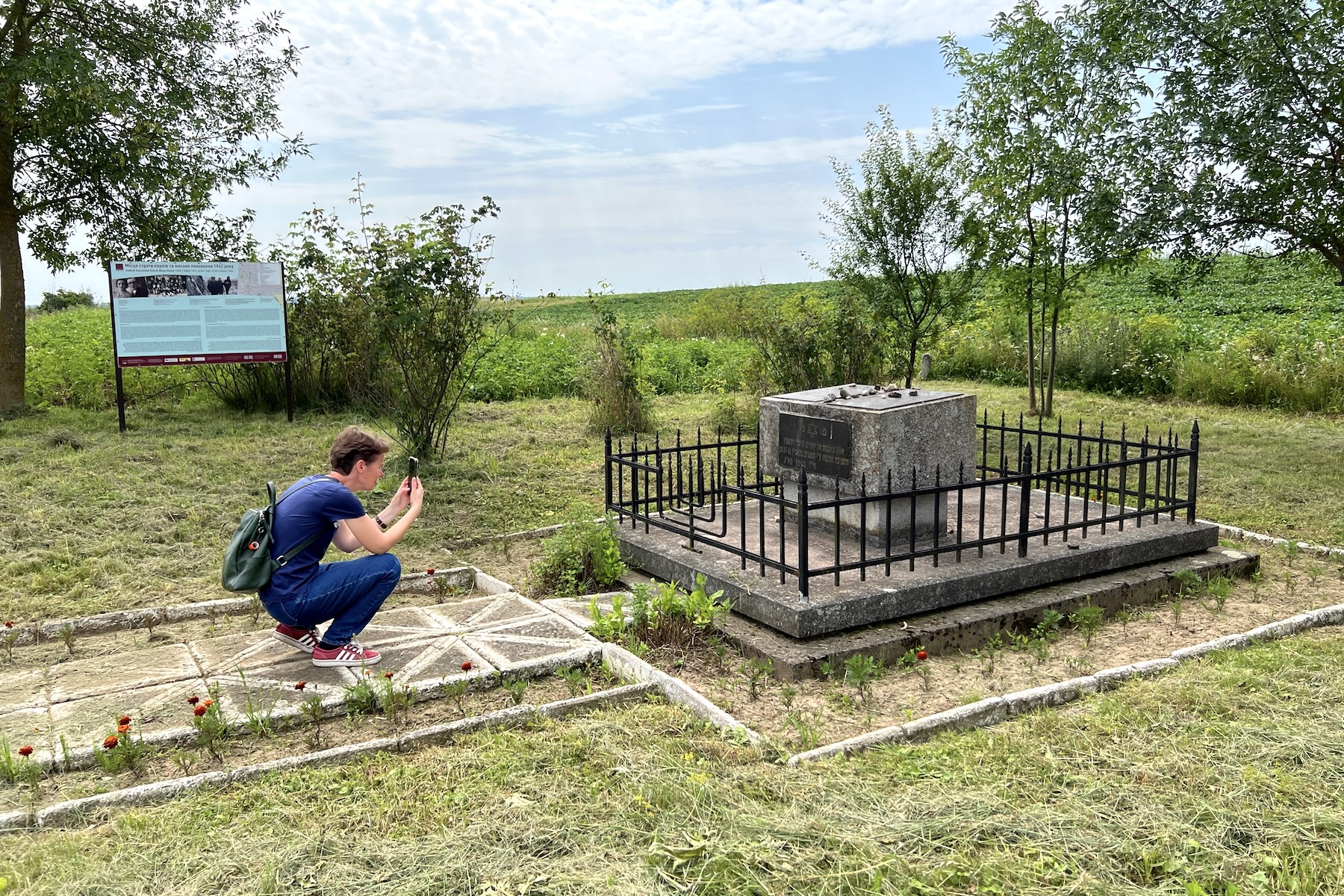
Tania photographing the memorial monument at the south mass grave site. Photo © RJH.
Our concepts for enhancing the physical protection of the mass grave at the south site remain sidelined because of the resource constraints due to the war and for lack of the significant funds needed to undertake the construction work. The efforts of our friend and NGO attorney Wito Nadaszkiewicz to secure legal registration and protection of the Jewish mass grave sites in Rohatyn also remain stalled while regional and national authorities are heavily focused on managing war-related relief efforts. However, in the meantime the Jewish grave sites continue to get needed regular attention and care, and circumstances in Ukraine today have actually raised awareness of past victims of militarized terror on these lands.
REMEMBERING LOCAL HOLOCAUST VICTIMS

Ira’s phonetic text of the Hebrew prayer as she prepared to read. Source: Iryna Nebesna.
This year Marla and I were not present in Rohatyn to observe the anniversaries of either of the largest Holocaust killing events in the city, but we are grateful to our Ukrainian friends and colleagues who traveled to Rohatyn to commemorate both days at the Jewish mass grave sites.
At the grave site south of Rohatyn, March 20 marked the 83rd anniversary of the first major aktion during the German occupation, during which more than 3000 Jewish citizens of Rohatyn and nearby villages were executed in a single day. Iryna Nebesna, a friend and journalist in Ternopil who has supported us and others in many heritage research and preservation events across western Ukraine, went in our place to read the prayer El Malei Rachamim (אֵל מָלֵא רַחֲמִים) and stand in silent witness to the memory of those killed and buried there. Ira had also joined us at the site the year before, as she has for both commemorative and heritage preservation events on several occasions since 2018.
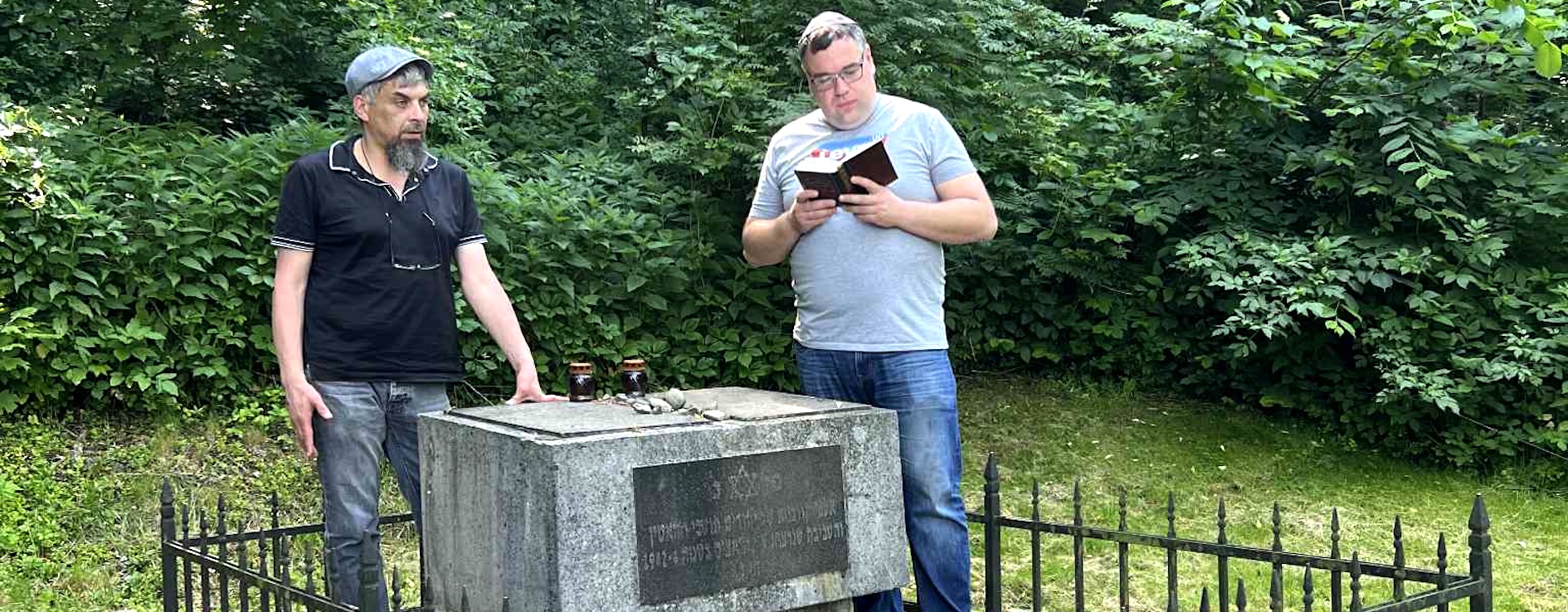
Denis and Sasha during the reading of El Malei Rachamim at the north site in June. Photo by Wito Nadaszkiewicz © RJH.
On June 6th, three colleagues and friends marked the 82nd anniversary of the start of the Rohatyn Jewish ghetto liquidation during which thousands of Jews from Rohatyn and many towns in the Rohatyn district were assembled, marched, and killed at a clay quarry site (today the city’s vodokanal) north of the city over three days. Longtime Jewish heritage activists in western Ukraine, Sasha Nazar and Wito Nadaszkiewicz (Wito is also our NGO’s CEO and attorney), were joined by Denis “Benya” of the Scholem Aleichem Cultural Center for a solemn ceremony at the mass grave site. Sasha read the El Malei Rachamim in Hebrew, and afterward the trio visited each of the other Jewish burial sites in Rohatyn.
ROHATYN HEADSTONE DATABASE PROGRESS
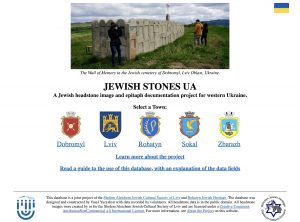
The home page of the headstone database project.
In last year’s annual report we described the documentation component of a large and multi-site Jewish headstone recovery project organized by our friend Sasha Nazar for the Sholem Aleichem Jewish Cultural Society of Lviv and the Lviv Volunteer Center of Hesed-Arieh, which includes headstones belonging to the Jewish cemeteries of Lviv, Dobromyl, Sokal, Zbarazh, and Rohatyn. While we had originally used the Rohatyn headstone recovery project to develop the online database design for the site we maintain called JewishStonesUA, in order to capture photo and transcription data from the other sites while those activists were available we delayed working on the Rohatyn portion except for initial trials. New headstone recovery and documentation work in Lviv further postponed the Rohatyn work through summer this year, and significantly amplified that portion of the database.
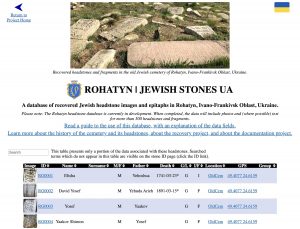
The top of the index page for the Rohatyn section of the database.
Finally, in the latter part of this year we were able to return to documentation of the recovered Rohatyn Jewish headstones. Partial translations of quite a few Rohatyn headstones photographed in the first years of the recovery project (from 2011 forward) were already made by the Rohatyn District Research Group (RDRG), and where available we are using those translations as a guide in our current work. This year RJH contracted with Tetiana Fedoriv, a Ukrainian historian with deep knowledge of Jewish culture and history from her own work fully documenting the new Jewish cemetery in her home town of Zbarazh (Ternopil oblast), to systematically transcribe in Hebrew all legible headstones in the Rohatyn cemeteries, and to translate the Hebrew to Ukrainian for use by students and others in Rohatyn and the region. From her Hebrew and Ukrainian texts and the prior RDRG translations, Marla and I are creating English translations following Tetiana’s progress.
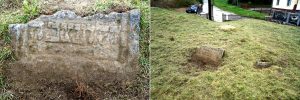
Two views of stone RG0020 from the database.
The Rohatyn headstone database will ultimately present images and data (epitaphs, symbols, materials, etc.) for more than 500 headstones which we have photographed since 2011. So far this year, with the help of Vasyl Yuzyshyn and Tetiana, we have uploaded data for all of the “grounded” stones (anchored in the old or new cemetery and coded RG in the database), some 54 stones, of which 17 have fully- or partially-legible epitaphs.
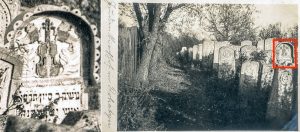
Two views from a prewar photograph of the missing stone RX0215,
not yet transcribed as of this report date.
Now in progress are images from two sets of prewar photographs of the Rohatyn old Jewish cemetery showing full or partial faces of interesting headstones lost in the Holocaust and not recovered. These stones, coded RX in the database, have been separated from the original photos into 57 distinct images, some of which are quite elaborate, but many of which are difficult to read. If others are able to discern words or characters we fail to see, the database can be easily updated.
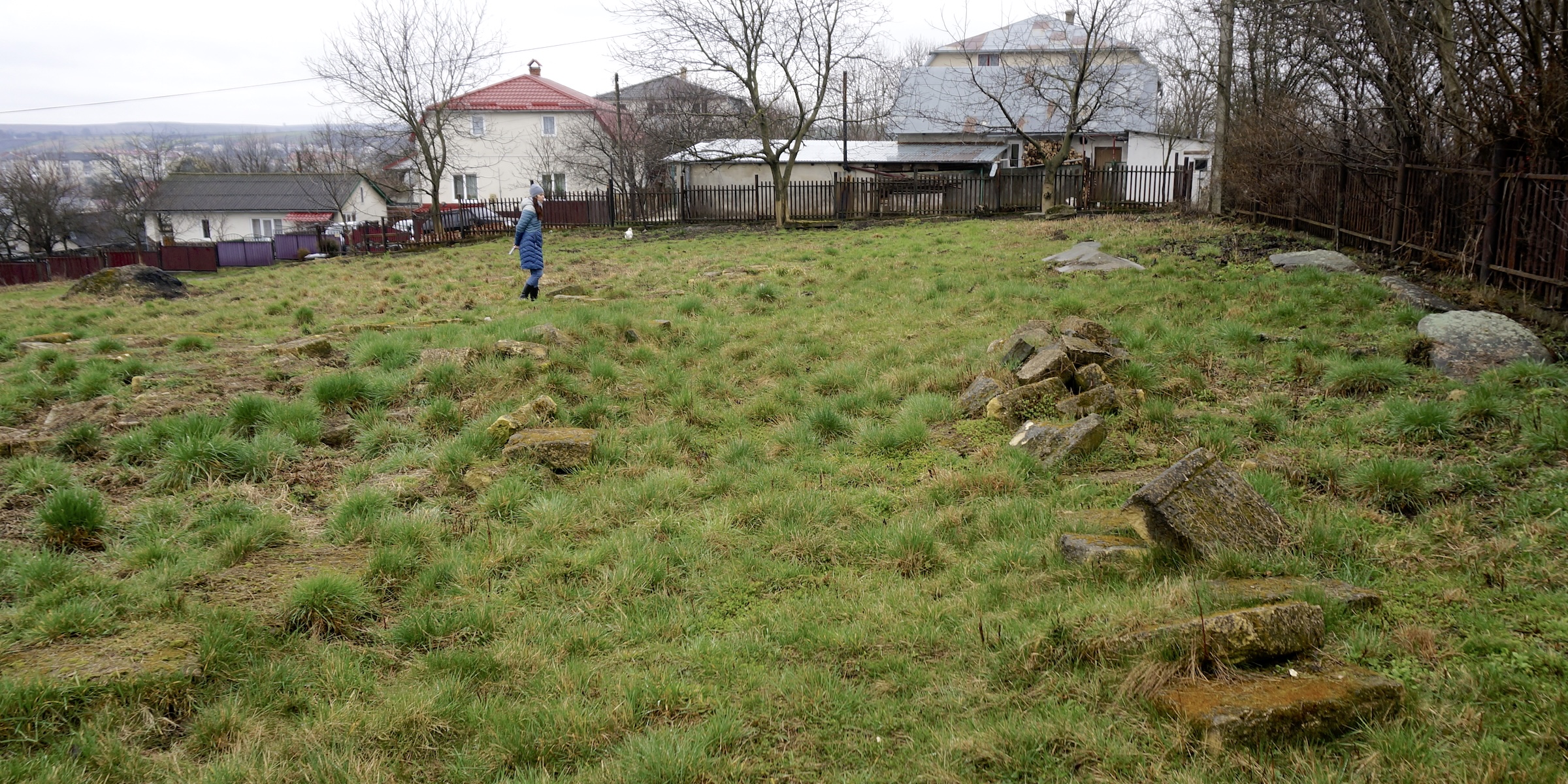
Some of the hundreds of headstones and fragments returned to the old cemetery and waiting to be databased. Photo © RJH.
The last set of headstones, also now in progress, includes the hundreds of loose stones and fragments recovered from outside the cemeteries since the end of WWII, the vast majority of which have been returned to the cemeteries through our project since 2011. We have already separated photos of more than 400 unique stones, most of which are only fragments of headstones, but many of which have at least partially-legible epitaphs. The documentation effort can be followed online as we work, and we will provide another update at the end of next year, if not sooner.
OTHER PROJECTS IN ROHATYN AND THE REGION
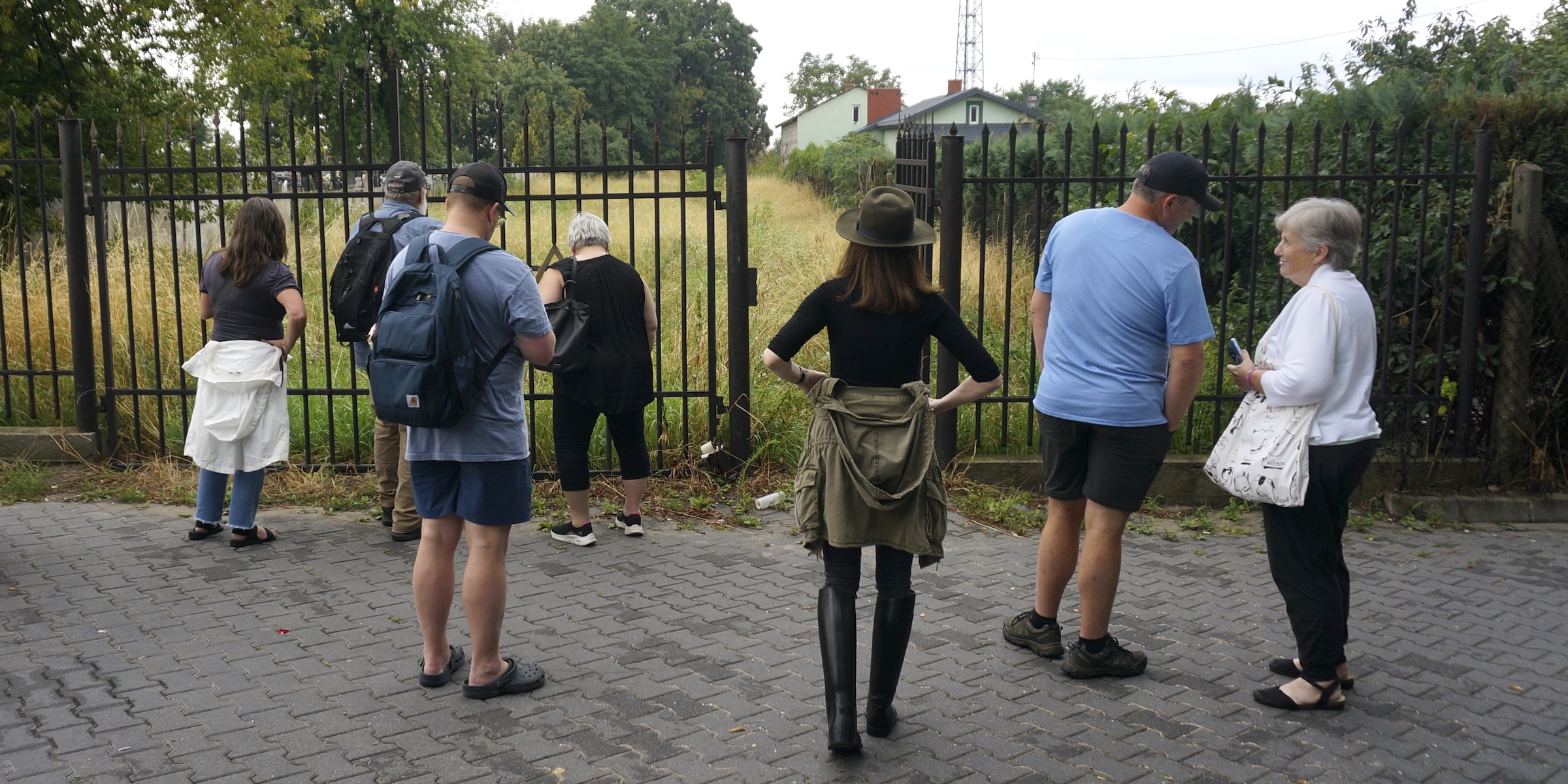
Marla and the TMF team assess the condition of the Grójec Jewish cemetery before the work begins. Photo © RJH.
Marla and I timed our travel this year so that we could join our friends and partners The Matzevah Foundation (TMF) in their volunteer work in July clearing vegetation and doing light maintenance at the Jewish cemetery in Grójec, a town in eastern Poland just south of Warsaw. TMF, a US-based Christian organization, has been organizing and conducting multi-day volunteer events caring for Jewish cemeteries in Poland for fifteen years, building on five prior years of efforts by their CEO Steven Reece, using hands-on work in the cemeteries with local partners and volunteers to help remember, restore, and reconcile as a shared effort to resolve some of the residual effects of the Holocaust.

Scenes from the first part of the project: walking the cemetery grounds before starting, preparing the tools, dragging large branches for disposal, and a visit from the mayor of Grójec. Photos © RJH.
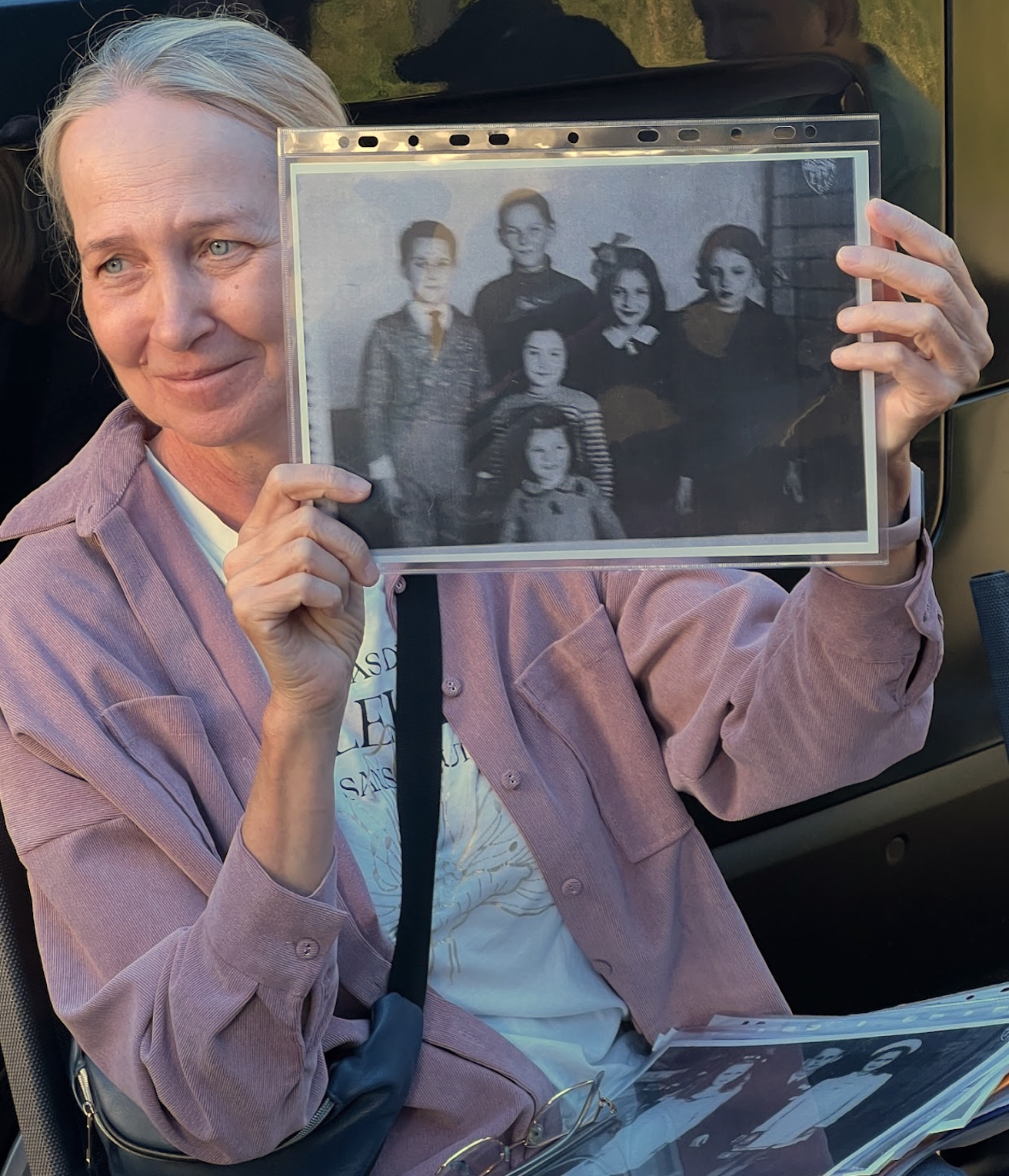
The local teacher explaining about a prewar Grójec Jewish family during a break in the work. Photo © TMF.
The Grójec event was the last of four TMF projects in 2025. Our association with TMF is more than a decade old now: we first shared strategy ideas with Steven in Warsaw and Vilnius in 2015, then joined TMF for a project of theirs in Nasielsk, Poland in 2016 to learn from them the basics of Jewish cemetery care and engaging local partners; we later also joined a project with TMF in Oświęcim, Poland, shortly before we moved to Lviv to support RJH. Two years later, as we were preparing to take full responsibility for rehabilitating the Rohatyn Jewish burial sites, TMF joined us in 2018 to head a major clearing and training effort in Rohatyn’s old Jewish cemetery, which helped us develop the tools, materials, and skills to lead large volunteer efforts for the next several years, until the burial sites were in better condition and the care could be managed by much smaller teams.

Scenes from the work in progress: with other volunteers, significant clearing already completed, painting the cemetery gate, the recovered headstone fragments from a construction site, and still more tree trimming. Photos © RJH.

TMF CEO Steven Reece with the preserved Jewish headstones at the land surveyor’s office. Photo © RJH.
In Grójec this year, TMF partnered with a local Baptist group which they had worked alongside in Otwock many years earlier, and with the two of us plus nearly two dozen local volunteers. Over four work days we cleared all of the known grave areas of tall grasses and new wild shrubs, trimmed trees, repaired concrete, and painted both the front gate to the cemetery and the symbolic fence around the wartime mass grave within the cemetery. Highlights of our time with TMF were the visit and brief lecture from a local school teacher who has focused her classes on the Jewish history of Grójec, the return of more than a dozen Jewish headstone fragments found near a construction site in town, and a visit to the office of a local land surveyor who himself secured displaced Jewish headstones discovered in roadworks decades ago and held them until he could identify a safe way to preserve them – our group of volunteers moved two headstones to the cemetery, and TMF made arrangements through the local Baptist group for the remainder to be moved with heavier equipment.

Scenes from the closing of the project: TMF leaders inspect the clearing work on the cemetery and the mass grave, repainting the inscription on the mass grave fence, gathering for final thoughts on the work and its meaning, and meeting with the land surveyor who saved Jewish headstones, with his son and his grandson. Photos © RJH.
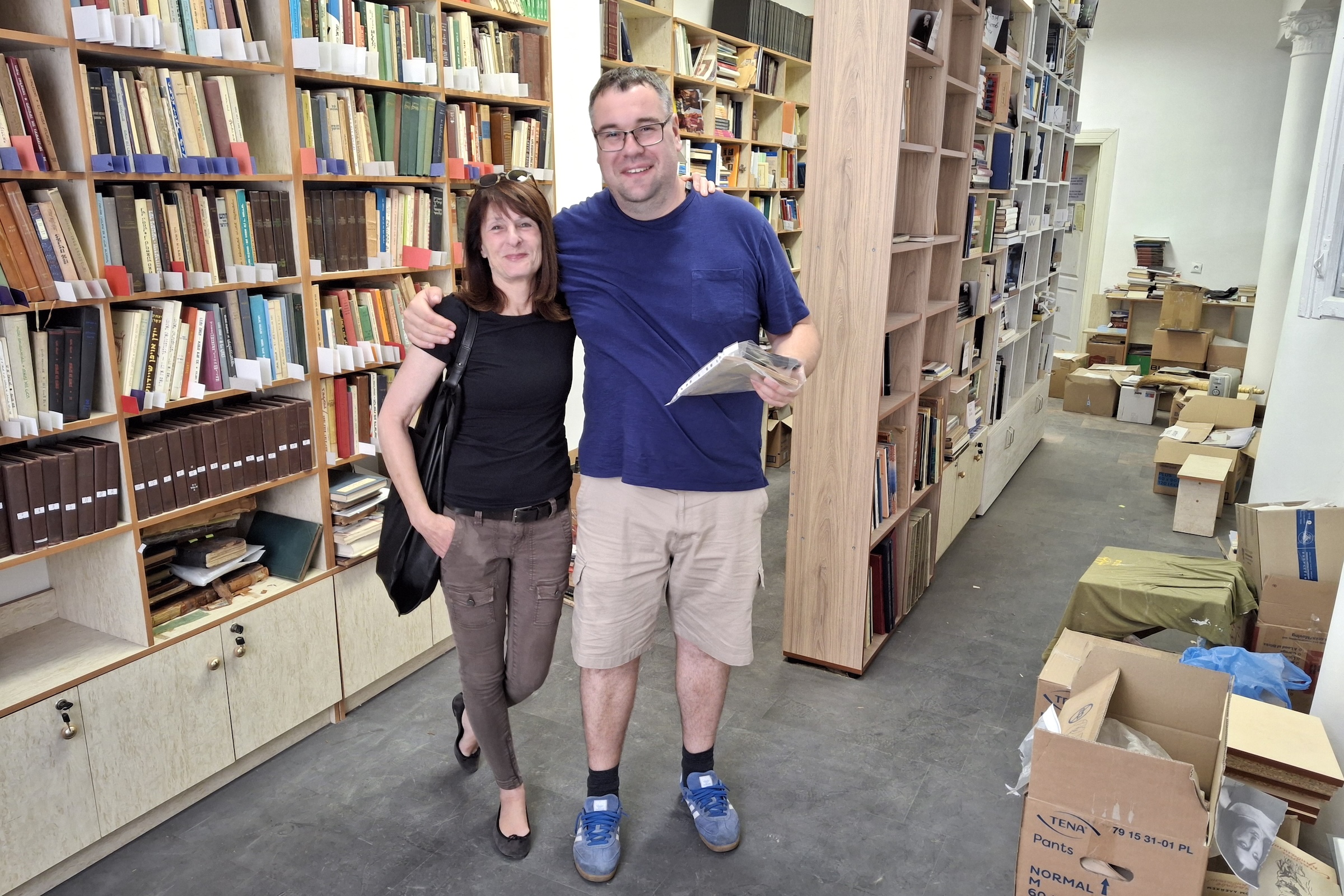
Marla with Sasha in the Jewish cultural library he is developing in the Coal Street Synagogue under renovation in Lviv. Photo © RJH.
During our visit to Lviv and Rohatyn in August, we reconnected in person with many of our friends and colleagues in the region. Key among those were Wito Nadaszkiewicz, our CEO and NGO attorney, who carries a larger role for us now that we are no longer living in Ukraine; Vasyl Yuzyshyn, who continues to support our work in data and communication as a part of the small RJH team; and Sasha Nazar of the Sholem Aleichem Jewish Cultural Society of Lviv, who continues despite severe challenges posed by the Russian war on Ukraine to find creative ways to preserve and promote Jewish heritage throughout the region. We were especially thrilled to have two Jewish heritage activists and close friends from the Ternopil oblast join us on our visit to Rohatyn: Iryna Nebesna and Tetiana Fedoriv, whose other activities and project work for RJH and Rohatyn Jewish memory are described elsewhere in this report.

Visiting with our friends at the Rohatyn central library this year. Photo © RJH.
While in Rohatyn we met with our friends at the central public library in the city, to thank them for their continued support and to make a personal donation for the purchase of library books, important now that book funds are critically constrained because of the war. The librarians have welcomed us and supported us since our first visits to Rohatyn in 2011, and they have continued to create opportunities for us to engage in two-way exchanges with Rohatyn citizens, even during wartime. Marla and I are sad that we made only a single visit to Rohatyn this year (compared to, for example, 36 visits in 2021), but grateful that our connection with the people of Rohatyn continues.
One project which was set aside until 2026 is the overlay map of one or two cold war U-2 aerial photographs of Rohatyn provided to us by one of the coordinators of the now-ended Ukrainian-German program Connecting Memory, as described in our annual report from last year. We should be able to take up this project after we complete the headstone database work for Rohatyn sometime in 2026, and upload the resulting overlay maps (like the 1944 Luftwaffe photo of Rohatyn) to the Mapping Rohatyn collection on this website.
ADMINISTRATION

Wito leading a training course on the use of tactical first aid kits, donated by his organization Poland Helps. Source: Wito Nadaszkiewicz via Facebook.
For the first year since Rohatyn Jewish Heritage was established as a Ukrainian NGO, in 2025 Marla and I were not employees of RJH because we did not require work and work permits for legal temporary residency; now we keep our former work roles and responsibilities, but as volunteers. This simplifies some of the administration of the NGO, but there are still actions required to maintain our NGO in legal and tax compliance with Ukraine’s laws, including document filings, reporting, and accounting.
As for the prior eight years, in 2025 our friend Wito Nadaszkiewicz, who is a longtime regional heritage advocate, continued to serve as our NGO’s attorney and chief executive through his firm LawCraft Legal Services and Consulting in Lviv, working together with his staff attorney Bohdan Zdanevych.
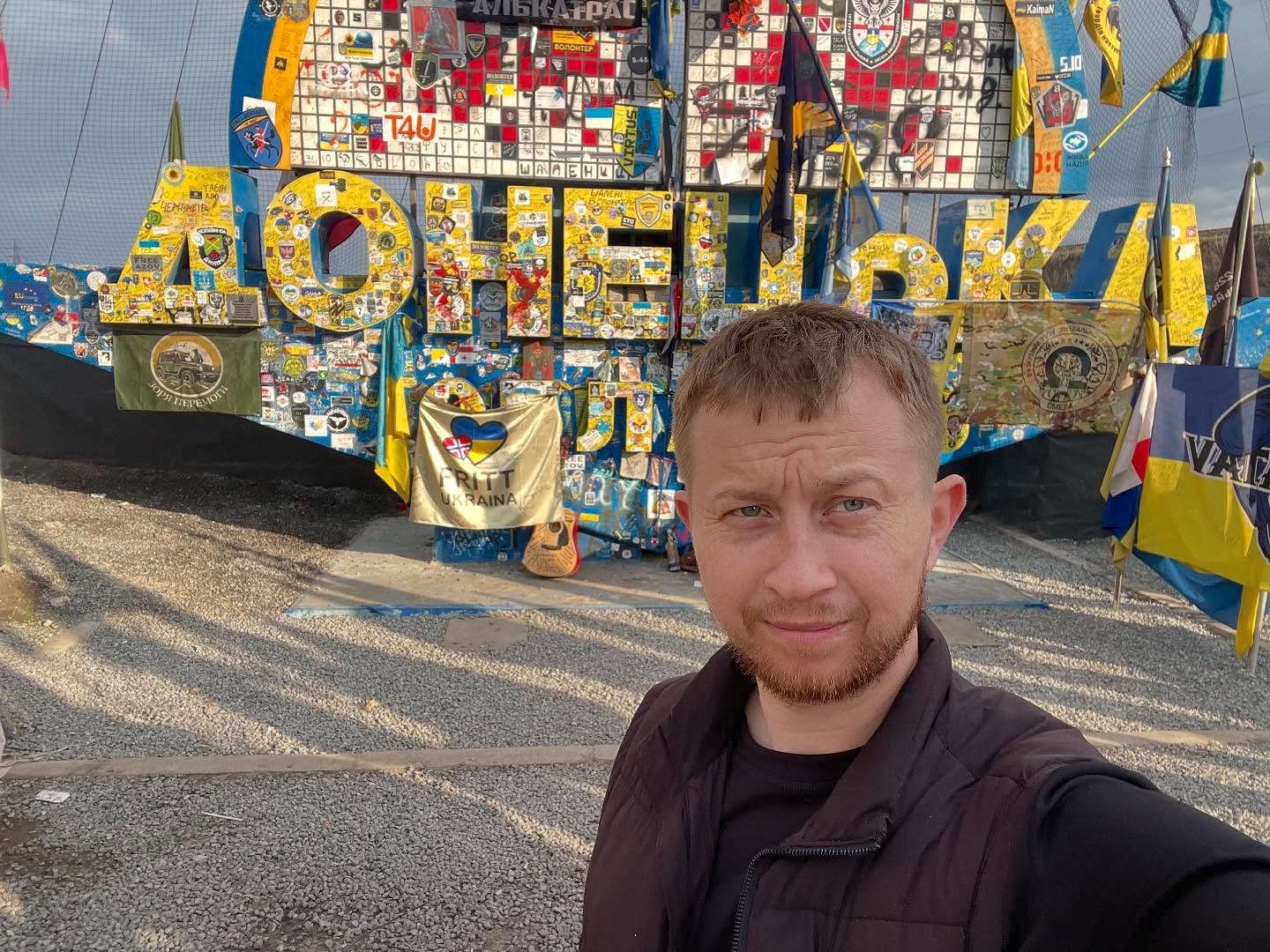
Bohdan delivering supplies to Pokrovsk in the Donetsk Oblast in eastern Ukraine in March of this year; the city fell under Russian occupation this month.
Source: Bohdan Zdanevych via Facebook.
The reduced administration required of our NGO this year was something of a blessing, because both Wito and Bohdan expanded their efforts to support the soldiers and the citizens of Ukraine both through their charitable organizations (Poland Helps and Siepomaga, and You Will Never Be Alone) and through their hands-on deliveries of essential medical supplies, food, computers, and much more (blood!), to civic leaders and hospitals, to military medical and logistics groups, and to ordinary civilians near the front lines of the war. Marla and I are astonished at the transformation of our “ordinary, office worker” friends into accomplished fund-raisers, negotiators, logistics coordinators, and transporters of humanitarian and life-sustaining goods both locally to refugees in the Lviv region and to far-away places on the edge of hell. These men have their priorities right, and we are grateful for the opportunity to support them even while they support us.
FINANCE
The ongoing burial sites groundskeeping effort dominated our NGO’s project expenses this year, partly because those costs have risen now that we cannot do the work ourselves, and partly because the breadth of our projects has narrowed due to the war and our absence from Ukraine. Donations to RJH were sharply down this year, the lowest by far since the NGO was registered and well less than half of this year’s expenses. We have prepaid the labor costs for the burial sites care for next year, but our remaining NGO assets for future project work are currently insufficient to carry our effort beyond 2026.
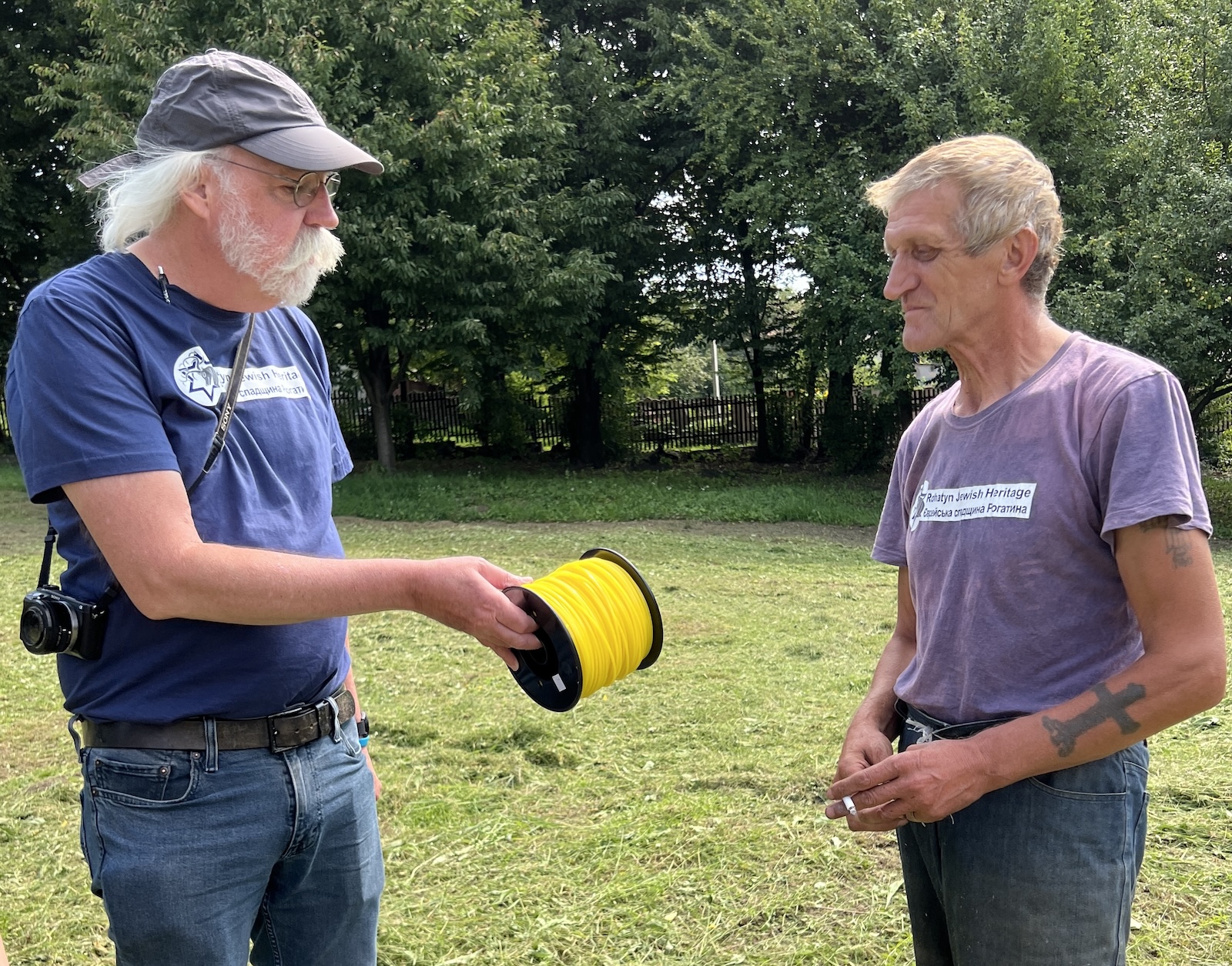
Sometimes sustaining the work at our heritage sites requires supplying hard-to-get materials. Photo © RJH.
Since the end of last year we have maintained project funds only in the US (with Gesher Galicia) and administrative funds only in Ukraine; this simplifies our accounting since the majority of project expenses are for labor and are currently paid to contractors in cash anyway. We aim for transparency by publishing our NGO income and expenses here, as in past years. We also record and acknowledge all donations (25 individual donations in 2025), and every donation goes directly to project expenses (less banking and transfer fees). Marla and I contribute additional money from our personal savings to cover all administrative, tax, and operational costs, plus some incidental project expenses. We also continue to volunteer our own time throughout the year to support project work and administration of the NGO, now mostly from the US, and we cover our own expenses including travel between the US and Ukraine.
NGO income and expenses for the calendar year 2025 are listed below in US$ and using a nominal exchange rate of US$1=40UAH to allow for transfer fees and rate fluctuation:
NGO projects & operations: US bank accounts
  start balance:                   +$ 8,098
  -----------------------------------------
  2026 burial sites groundskeeping -$ 3,900
  misc. project labor              -$   700
  headstone recovery               -$     0
  tools, parts & accessories       -$    81
  ground transport Lviv/Rohatyn    -$   300
  transcription & translation      -$   490
  headstone database data transfer -$   710
  printing, books, archive fees    -$    29
  project legal services           -$(comp)
  website domain, hosting, apps    -$   861
  banking & wire transfer fees     -$    11
  -----------------------------------------
  net change 2025:                 -$ 7,082
  individual donations via GG      +$ 2,452
  other donations                  +$     0
  -----------------------------------------
  net end project balance:         +$ 3,468

NGO administration: UA bank account
  start balance:                   +$ 2,435
  -----------------------------------------
  permit and gov't fees            -$   155
  accounting and bank fees         -$ 1,268
  salaries+benefits+taxes          -$     0
  -----------------------------------------
  net change 2025:                 -$ 1,423
  Osborn personal contribution     +$ 1,800
  -----------------------------------------
  end admin balance:               +$ 2,812

This is the 12th year of Gesher Galicia support to RJH.
The figures shown here are current, and may include updates since first reporting to include late-year donations or expenses, and a final reckoning by our NGO accountant.
Again this year and always, we gladly and gratefully thank Gesher Galicia for its volunteer contributions, and in particular their Membership Chair Marsha Shapiro, CFO/Treasurer Darcy Stamler, and President Steven Turner, for making the donations process to Rohatyn Jewish Heritage tax-deductible for US taxpayers and simple for everyone.
LOOKING FORWARD: EVOLUTION OF HERITAGE MANAGEMENT

Apartment building in Ternopil after a Russian attack on the city during the night of 19 November 2025. Source: ДСНС State Emergency Service of Ukraine in Ternopil Region via Wikimedia.
The first line of the national anthem of Ukraine is, roughly, “Ukraine’s glory and freedom have not yet perished”, and despite more than a decade of war by Russia on Ukraine and almost four years of intense attacks on both military and civilian targets across the country, that truth still holds. But the damage to infrastructure and the loss of resources for anything more than survival are huge; Ukrainians continue to adapt as they have become war in outsiders’ eyes, strangers in a strange life that maps to none other. Even though the most significant battles happen hundreds of kilometers away from Rohatyn and Lviv, western Ukraine has not escaped direct attacks by missiles and explosive drones, killing civilians and severely damaging residential and commercial buildings, utility networks, rail lines, and more. Now living in the US, Marla and I are safe from these attacks, but our colleagues and contractors are not, and with so many men serving in various forms of defense and humanitarian relief roles now we can only keep the most basic heritage work in progress.
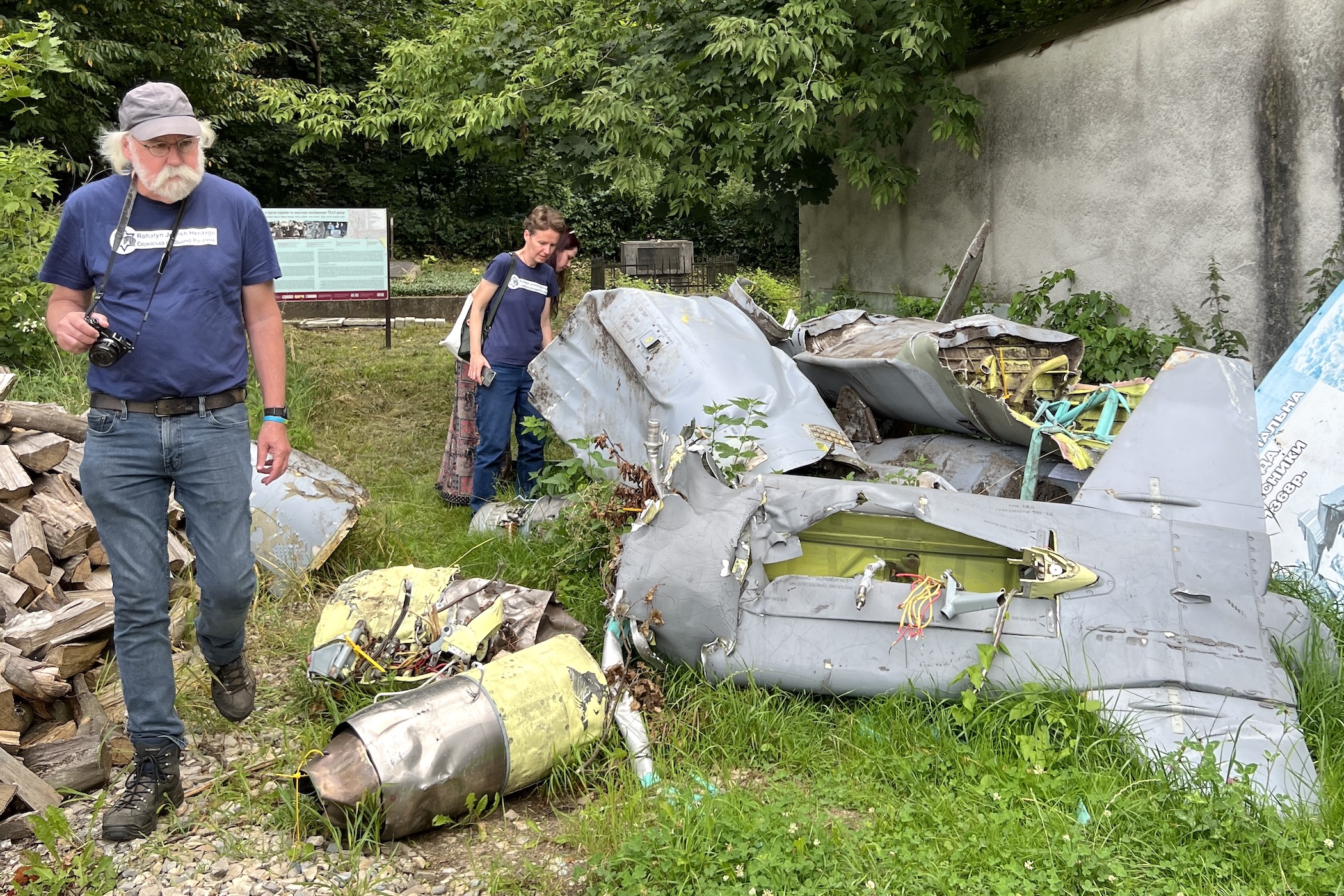
Debris from downed Russian drones stored temporarily in front of the north mass grave memorial in Rohatyn this summer. Photo © RJH.
Just last month, Russian cruise missiles struck two apartment buildings in Ternopil (80km/50mi from Rohatyn) on the night of 19 November, killing at least 35 civilians including six children, in an effort to divert emergency services from simultaneous strikes on an industrial complex which was the primary target of the Russian attack. Overall in that one night, Russia launched at least 470 drones and 48 missiles against Ukraine, prioritizing the west. Closer to “home” the same night, debris from downed missiles and drones damaged nine homes in the village of Verbylivtsi less than 2km/1mi south of the Rohatyn city center, and scattered cluster munitions around the impact sites. Earlier this year, downed drone parts from Putiatyntsi were collected at the vodokanal facility in Rohatyn, creating a sinister tableau with the north mass grave memorial, the residue of war crimes eight decades apart.
Damage to a building in Verbylivtsi from the Russian attack last month.
Source: Serhiy Nasalyk via Suspilne Ivano-Frankivsk.
Marla and I intend to visit Rohatyn again in 2026 to review the status of the two Jewish cemeteries and two Jewish mass grave sites, and to meet with our friends and colleagues in Lviv and the region. The RJH NGO project work is now primarily focused only on that groundskeeping work and on the headstone database digital project; we have no real capacity to take on any other physical projects while the war rages, and no funds with which to start anything new, though we will of course support the recovery of any new headstones which are discovered outside the cemeteries. Even the burial sites care is at risk going forward because of the age of our two contractors, so during the coming year we will be exploring other options, possibly including a contract with a larger heritage institution in Ukraine.
THANK YOU TO OUR SUPPORTERS
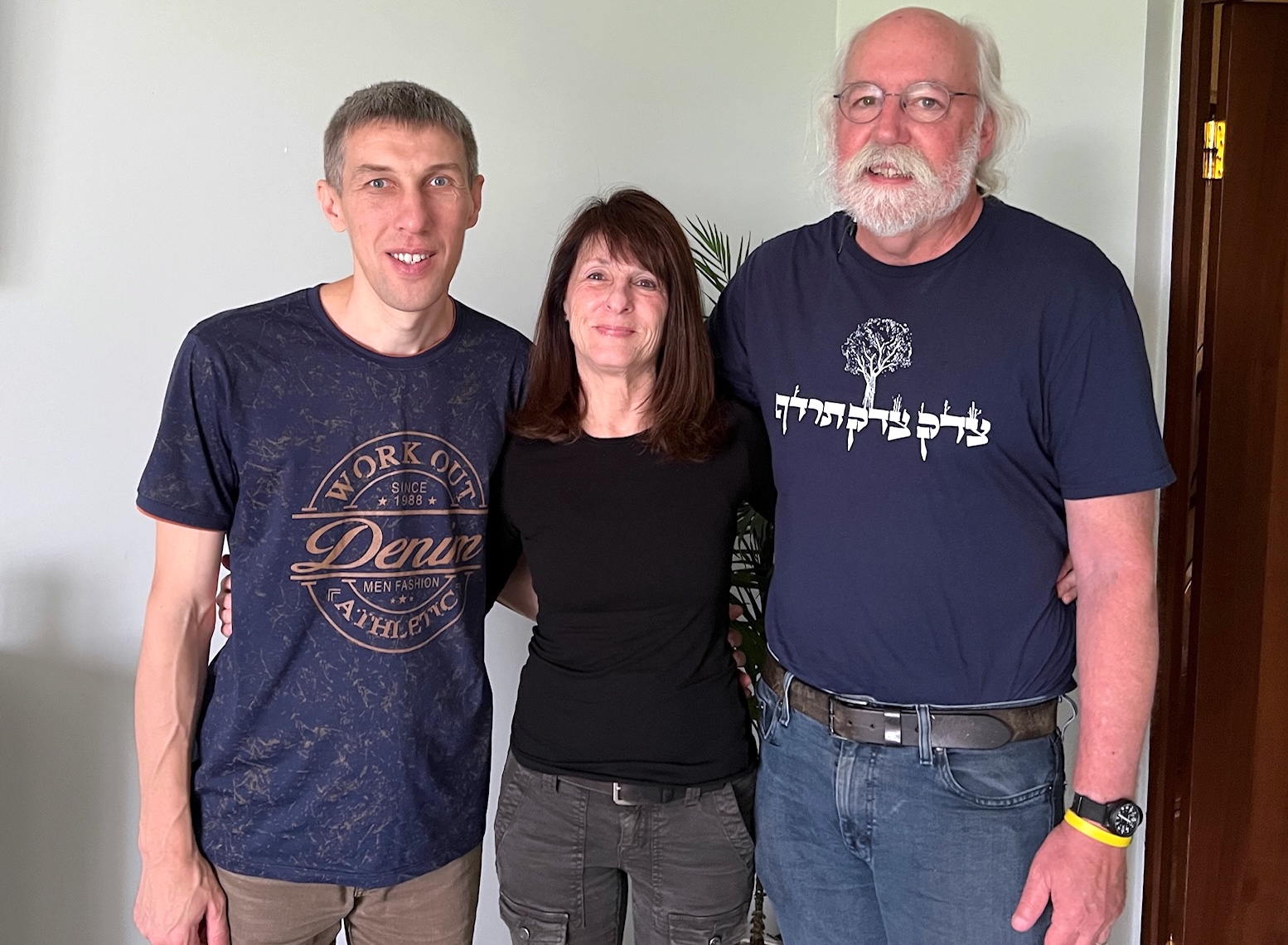
With our dear friend Vasyl this year. Photo © RJH.
Nothing brings a smile to our faces faster than working with our friends and colleagues in the heritage field in western Ukraine and on projects which promote Rohatyn’s Jewish history. Again this year as in every year since the founding of our NGO, our dear friend and core RJH team member Vasyl Yuzyshyn helped us in nearly all of our activities with local communication, text translations, and as the driver for much of our digital work, including the recovered headstone database. He is a joy to work and communicate with, taking care in all he does and bringing humor to our exchanges to relieve the stresses of outside dangers.

Working with Tania in the old Jewish cemetery in Rohatyn. Photo © RJH.
After working alongside her last year as volunteers on the broader Jewish headstone database project, this year we are very pleased to bring our kind and knowledgeable friend Tetiana Fedoriv into direct collaboration on the large Rohatyn portion of that database, giving us access to her skills and experience for the benefit of everyone interested in the precious stones we have been collecting over the years. Tania is absolutely driven in the study and elaboration of Jewish epitaphs, and it often becomes amusing trying to keep up with her.

Andriy Muzyka with students from Potik at the old Jewish cemetery in Rohatyn. Source: Iryna Muzyka via Facebook.
As with the librarians at the Rohatyn central library, often support for our work and our goals comes from friends who we have met with only occasionally over the years. A good example this year came from Andriy Muzyka, head of the Museum of the History of Lviv on the Old Town Square, who previously volunteered to help clear the Rohatyn old Jewish cemetery in 2022. In August, as part of his education work in the communities close to his roots, Andriy brought a group of students from the nearby village of Potik to visit the historic cemetery and to learn about the Jewish community which established it.
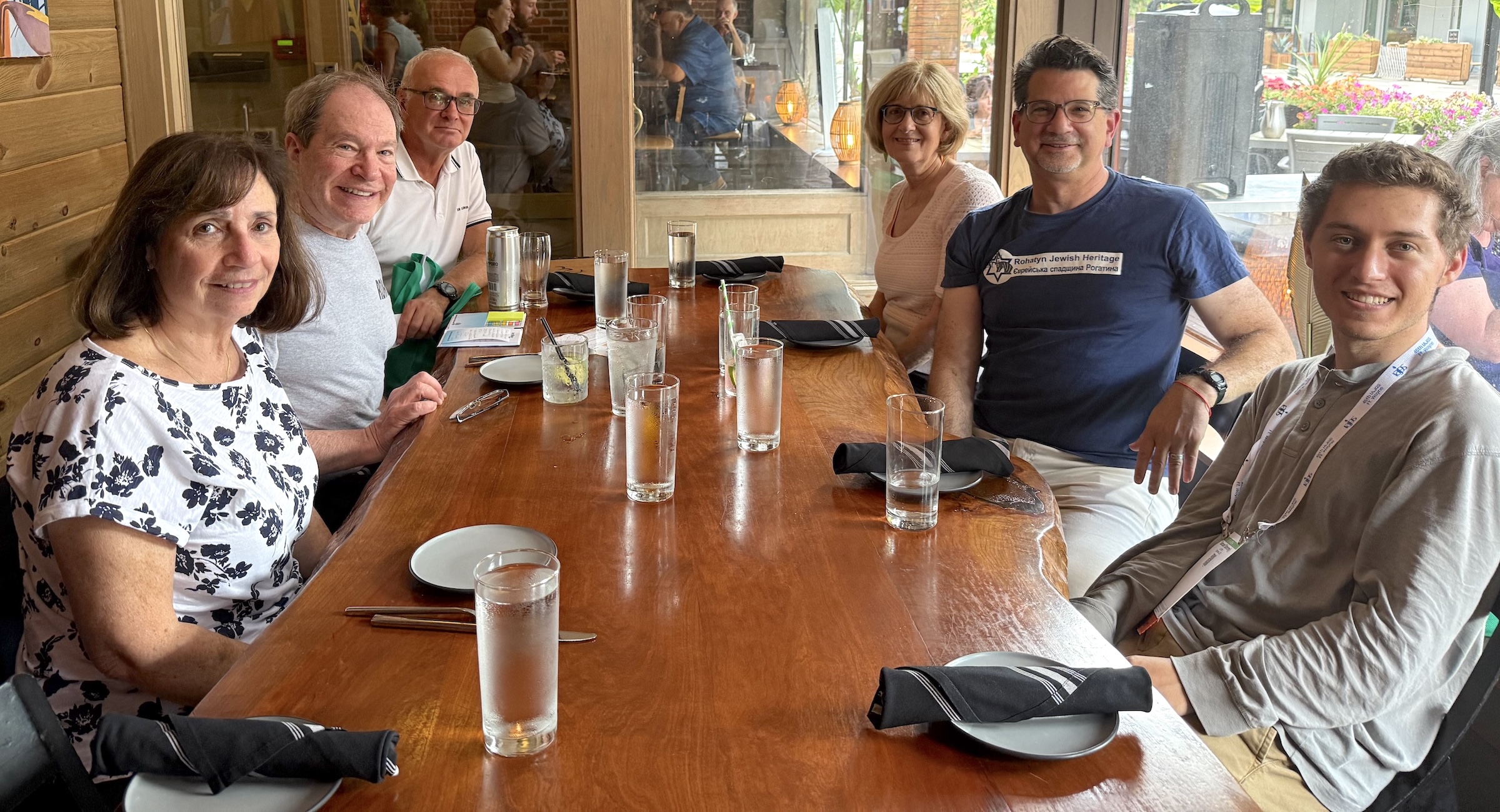
Friends and supporters with the RDRG and Gesher Galicia at a Jewish genealogy conference this year. Source: Dr. Alex Feller via the RDRG.
Again this year we would like to thank the several organizations which supported us in 2025 and in past years with both tangible and intangible support, including the City of Rohatyn and our NGO partners (and friends) the Sholem Aleichem Jewish Cultural Society of Lviv, the Lviv Volunteer Center, ESJF European Jewish Cemeteries Initiative, the Ukrainian Center for Holocaust Studies (UCHS), the former coordinators of Connecting Memory, Yahad – In Unum, the Rohatyn District Research Group (RDRG), and Gesher Galicia.
We are also very pleased to thank and acknowledge the individual volunteers who gave their time and hard work to us in 2025, and the individual donors who provided funding this year to sustain our work in Rohatyn, many of whom have donated in years past as well. We are honored to list this year’s and past donors on our website.
And we are amused and happy to present another collage of photos of friends wearing our RJH t-shirts this year; it’s a smaller collection than in past years, but also features more small models wearing the shirts! This always makes us laugh, and you can consider this a reward for making it to the bottom of this long report…

We dare you not to smile…!